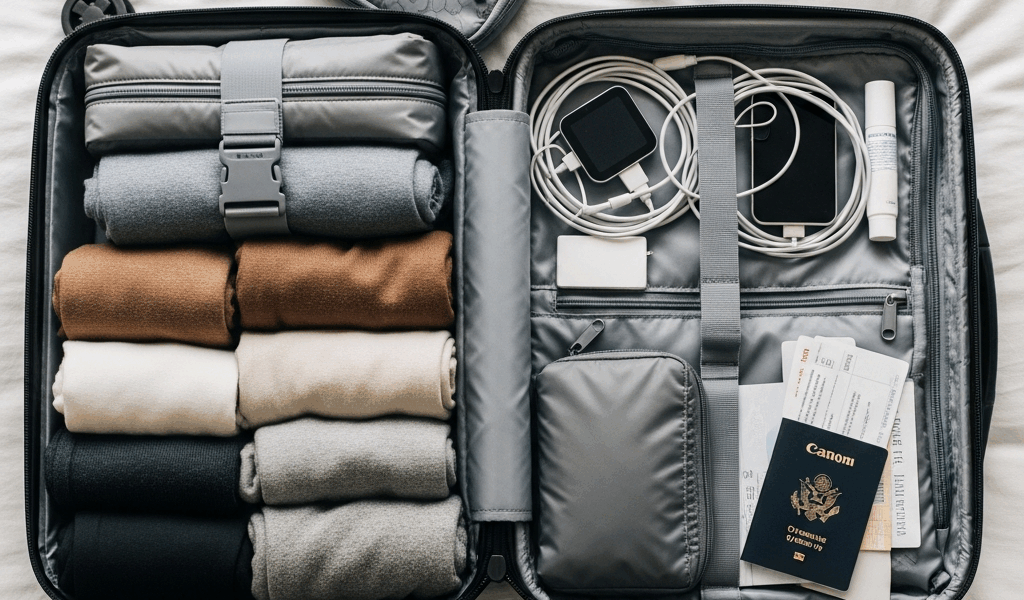
Why Most Two-Week Packers Get It Wrong
Two-week carry-on packing has gotten complicated with all the “ultimate guide” noise flying around. Everyone’s got a system. Everyone’s got a list. And somehow, smart travelers still end up sitting on their suitcase at the airport, sweating through a shirt that won’t fit in the overhead bin.
The mistake isn’t laziness. It’s math — or the total absence of it. Fourteen days doesn’t mean fourteen complete outfits. It means fourteen days of wearing combinations. A pair of dark jeans works on day one and day eight. A white t-shirt layers under three different things. The mental shift from “one outfit per day” to “mix-and-match pieces” cuts your packing volume nearly in half. Most people never make that shift. They fail before they even open the bag.
Today, I’ll share everything I’ve learned — including the embarrassing parts.
Choose Your Bag Before You Pack Anything
Probably should have opened with this section, honestly. The bag decides everything. Not the other way around.
A solid carry-on sits between 40 and 45 liters. That’s the sweet spot — big enough for a real two-week trip, small enough to fit overhead on international carriers. The Osprey Farpoint 40 and the Cotopaxi Allpa 42 are the benchmarks. Real bags. Proven dimensions. Anything under 35 liters creates artificial constraints. Anything over 46 liters tempts you to pack like you’re checking luggage, which defeats the whole point.
I’m apparently a slow learner, and I bought a 32-liter “carry-on” off Amazon reviews once. Spent two hours on packing day realizing I’d already lost the game before the trip started. The bag was too small for any realistic itinerary — I either had to check a bag anyway or cut so aggressively I felt genuinely underprepared the whole trip. Don’t make my mistake.
Look for a clamshell opening — a bag that unzips completely flat, like a book. This is non-negotiable for a working packing system. Vertical zippers and roll-top closures force you to pack in blind layers and pray. That’s fine for a weekend. It’s chaos for two weeks. A structured clamshell lets you see everything at once and pack with actual intention.
Pair it with a personal item — a small backpack or crossbody bag. Electronics, documents, a packable layer, snacks. It’s not bonus luggage. It’s part of your total allocation, and every airline allows it.
The Clothing Math That Actually Works
But what is a real packing framework? In essence, it’s this: 1 pair of shoes worn, 2 bottoms, 3 tops, 4 changes of underwear and socks. That’s your foundation. Everything else is addition — not multiplication.
One pair of shoes worn sounds reckless until you remember you’re traveling, not pouring concrete. Wear them on the plane and they’ve already served two purposes. I’m apparently a merino wool convert, and Smartwool socks at $24 a pair work for me while cotton athletic socks never survive past day three without problems. Pack two additional pairs of merino and you’ve covered fourteen days with four total — because merino genuinely doesn’t smell after one wear.
Two bottoms is where most people spiral. Dark jeans and one pair of lightweight chinos or linen-blend pants. That’s it. Wear one while the other dries — yes, hand-washing happens on two-week trips, and it takes about ten minutes. Bottoms stay clean longer than tops, they stack flat, and they repeat endlessly without anyone noticing or caring.
Three tops is your flexibility zone. A long-sleeve merino wool base layer — $40 to $60 from Icebreaker or Patagonia. A t-shirt or lightweight crew. A button-up or overshirt that reads casual or semi-formal depending on context. These three rotate constantly. Combine them — t-shirt alone, t-shirt under button-up, base layer as a nightshirt — and you’ve built eight distinct visual looks from three pieces. That’s what makes the merino-and-layers approach so endearing to veteran carry-on packers.
Four changes of underwear means laundry hits on day four or five. Cold water in the hotel sink, a bar of travel soap, wring everything out, drape it over the bathroom fan or radiator overnight. Done by morning. Every time.
Fabric matters more than the brand name on the tag. Merino wool repels odor naturally — actual science, not marketing language. Synthetics dry faster than cotton. Avoid pure cotton t-shirts if you’re hand-washing. Patagonia’s Capilene line, Uniqlo’s AIRism, anything labeled “travel fabric” earns the slightly higher price through function. Pure cotton punishes you at the sink.
How to Pack the Bag So Nothing Gets Crushed
Packing order matters. Gravity works. Use both.
Lay your bag completely flat and open. Heaviest items go on the bottom: jeans, shoes in a Matador FlatPak Shoe Bag — $25, compresses to almost nothing — and your base layers. These anchor everything above them and don’t shift mid-flight.
Roll your clothes rather than fold them. Rolling compresses better and avoids the crease lines that flat folding creates. The exception is structured button-ups — fold those along the seams. Socks and underwear roll or bundle. Wrinkles on a two-week carry-on trip are background noise. Nobody’s ironing in a hotel bathroom in Porto.
Packing cubes help if organization is genuinely your weak spot. A $12 set — search “compression packing cubes” on Amazon, generic equivalents work just as well as the $60 branded ones — divides your clothes into categories and compresses them slightly. But they’re not mandatory. If you’re disciplined about placement, you don’t need them. Just don’t pack like you’re stuffing a duffel before a 6 a.m. flight.
Toiletries and electronics go in a designated front-pocket pouch. Not jammed in last. Not on top, where weight crushes everything below. Liquids in a separate clear bag — TSA’s 3-1-1 rule applies to carry-ons: 3.4-ounce bottles maximum, one quart-sized bag, one bag per person. That’s the rule. Plan around it.
The number-one crushing mistake: overstuffing the top pocket because “there’s space.” There isn’t. That’s decompression room. Fill it and your bag becomes a brick that technically closes but ruins everything inside.
What to Cut When Your Bag Still Won’t Close
So, without further ado — if the bag won’t close, something leaves. This is the moment you actually discover what you need versus what you brought out of anxiety.
One decision rule covers most of it: if you’re packing it “just in case,” it goes. That extra sweater for unpredictable cold? Gone. The backup pants in case your jeans mysteriously wear out? Gone. Two weeks isn’t long enough to justify insurance clothing. It just isn’t.
Three categories destroy carry-on packers specifically — shoes, toiletries, and rain gear.
Frustrated by sore feet on past trips, most people pack four or five pairs of shoes — a travel shoe, a casual shoe, a dressier option, two backups “just in case.” Cut it to one worn pair plus one additional. Two total. You genuinely do not need hiking boots, dress shoes, and running shoes for fourteen days. The shoe-per-outfit mentality is the single fastest way to lose the carry-on game entirely.
Toiletries burn people because full-size items feel like preparation. Full-size deodorant, two shampoos, face wash, face cream, body lotion, sunscreen — each one weighs almost nothing alone. Stacked together, they’re a brick. Travel-size everything. Accept that you’ll buy toothpaste abroad if you run out. Most countries have toothpaste. Seriously.
Rain gear — one lightweight packable jacket. Patagonia’s Houdini is $99 and folds into a pouch roughly the size of a large apple. One. Not a full raincoat and a backup windbreaker. You will wear one. The other will sit in your bag for fourteen days making everything tighter.
Here’s the reassurance nobody gives you: most things can be bought on the road. Forgot a belt? Five dollars. Deodorant ran out? Pharmacies exist in every country you’re visiting. Underestimated the cold? Every city has a clothing store. Travel isn’t an island. You’re not cut off from commerce — you’re just in a different city than usual.
The hardest part of carry-on packing for two weeks isn’t the packing itself. It’s trusting that you’ve packed enough. You have.

Leave a Reply