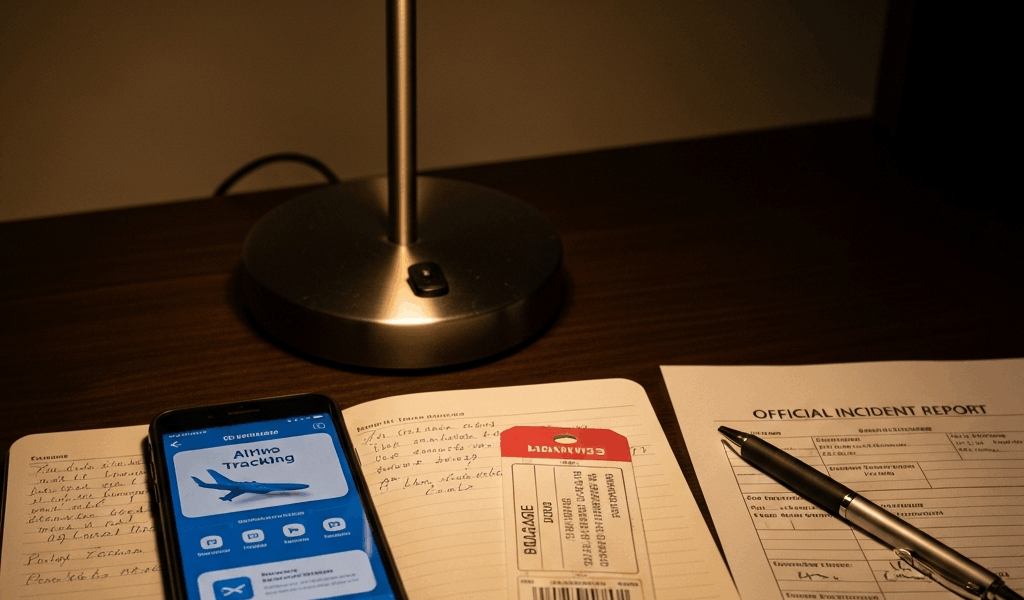
Do This Before You Leave the Airport
Lost luggage has gotten complicated with all the conflicting advice flying around. As someone who watched my own bag disappear somewhere between Denver and Boston, I learned everything there is to know about what actually works. Today, I will share it all with you.
The next 30 minutes after you realize your bag is gone — those determine everything. Whether you walk away with full compensation or get a polite shrug depends almost entirely on what you do before you leave that terminal.
Do not leave the airport.
Walk straight to the airline’s baggage services desk. Not the ticket counter. The baggage desk — they’re different, and agents at the wrong desk can’t help you. Ask for the duty agent specifically. Then say this: “My bag didn’t arrive on flight [number]. I need to file a Property Irregularity Report right now.” Use the acronym PIR. Say it out loud. You sound prepared instead of panicked, and that distinction changes how they treat your case.
They’ll print a form. Watch them fill it out. Bag color, size, contents, your contact details — all of it matters. Ask them to mark the status as “delayed” rather than “lost” if you’re not certain. That single word affects your compensation options down the line.
Get your reference number. Write it down on paper — actual paper. Photograph the entire PIR form with your phone. Screenshot the agent’s name if it’s visible anywhere. Then ask: “What’s your interim expense policy if my bag takes a few days?” Most agents get a slightly surprised look. Most passengers never ask. The airline has a policy. They just don’t volunteer it. Get it in writing — ask them to email it or write it on the back of your copy.
Before you leave that desk, get the direct phone number for baggage follow-up at your destination airport. Not the main 1-800 number. The actual baggage office. Save it in your phone right there, and put “URGENT” in the contact name so you find it fast at 7 a.m. when you’re calling half-asleep.
How to Track Where Your Bag Actually Is
Baggage tracking has gotten better and worse at the same time. Better because status updates exist now. Worse because airlines routinely sit on information for 48 hours before pushing anything to passengers.
Open your airline’s app immediately and search using your PIR reference number. You’ll see status codes — “In Transit,” “Delayed,” “At Airport,” “Damaged.” Here’s the thing about “In Transit”: it doesn’t mean what it sounds like. It typically means your bag reached a hub but missed its connection. Atlanta, Dallas, Chicago — those three airports account for a staggering percentage of connection failures. That’s where bags go quiet.
The airline runs something called WorldTracer, an international baggage database shared across carriers. You can’t access it yourself, but any agent can. Ask them — specifically — to pull your bag’s last known location from WorldTracer. That’s how you find out if it’s sitting in a warehouse in O’Hare or legitimately in the system somewhere.
Tracking apps update once, maybe twice a day. Call the baggage office every morning anyway. I know that sounds like overkill. It’s not. A human on the phone can tell you things the app can’t — whether your bag is genuinely lost versus waiting on a delivery truck that runs Tuesdays and Fridays only. Don’t make my mistake of trusting the app exclusively for four days while my bag sat 12 miles away.
Day 21 is the threshold. That’s when your bag officially becomes “lost” under airline regulations — not arbitrary, it’s baked into international air travel rules. Mark that date on your calendar the moment you file your PIR. Everything about your claim changes before and after that line.
The AirTag factor
AirTags help. They’re not magic. Put one in your bag — the $29 is worth it — but understand what they’re actually good for. Checked baggage tends to block Apple’s Find My network signals for the first couple of days in airline custody. If the tracker goes dark right after you check in, that’s normal. Where AirTags genuinely shine is theft from a carousel, not a bag stuck in airline infrastructure. Still worth it. Just calibrate your expectations.
What You Can Claim for While You Wait
Probably should have opened with this section, honestly. Most people have no idea they can start spending money on essentials immediately — and get reimbursed.
The DOT doesn’t mandate a specific daily cap for domestic delays. But the airlines themselves do. United, American, Delta — most major carriers cover somewhere between $50 and $200 per day for reasonable essentials. Toiletries, one outfit, prescription medications, underwear. They cover those. They will not cover a $400 replacement suitcase or a designer jacket. Reasonable essentials.
Keep every single receipt. CVS receipt for a $4 toothbrush? Keep it. Target receipt for a $22 emergency shirt? Keep it. A crumpled gas station receipt for travel-size shampoo? Keep that too. Airlines want photo proof. Give them photo proof.
Call before you spend aggressively. Say exactly this: “I need to purchase essentials while my bag is delayed. What can I claim, and what’s the daily limit?” Then ask them to confirm that number by email. Without written confirmation, an agent can later call your purchases “excessive” and deny reimbursement. That word — excessive — gives them wiggle room. Don’t give it to them.
International flights run under different rules entirely. The Montreal Convention governs most international air travel and caps total liability around $3,500 USD equivalent — but that’s a ceiling on everything, not a daily expense allowance. EU261 adds separate protections on European routes. Know which framework applies to your specific flight before you file anything. The gap between them is significant.
How to File a Compensation Claim That Actually Pays
Filing a claim and filing one that gets paid — those are genuinely different processes.
Pull together everything: interim expense receipts, photos of your bag, the original baggage receipt from your boarding pass, and your PIR number. Build a simple spreadsheet. Date, amount, what was purchased. Airlines process hundreds of claims weekly. An organized claim with a clear paper trail moves faster than a messy email chain with attachments in random order.
Calculate depreciated value, not replacement value. That leather briefcase you’ve carried for eight years is worth $150 to an airline adjuster, not $600 new. Be realistic and document what you owned — old credit card statements, purchase receipts if you have them, or clear photos of the bag and contents. Inflating claims invites rejection.
File the formal claim within 30 days of your PIR. Most airlines have online portals now — use them, because every action gets timestamped. If they deny you later, you need to prove you filed correctly and on time.
Here’s what airlines are quietly hoping you skip: file simultaneously with your travel insurance provider and your credit card’s travel benefits program. I’m apparently a Amex Platinum cardholder and that card works for me in ways my previous Visa never did — specifically the baggage delay coverage. These layers stack on top of airline compensation. The airline pays first. Your card or insurance covers the gap up to their own limit. I recovered $300 from my airline and another $400 from Amex because I filed both claims the same afternoon. Don’t make my mistake of waiting to see what the airline offered first.
If their settlement offer feels low, push back with itemized receipts and a clear description of contents and condition. You’re not being difficult. You’re being thorough. Those are different things.
How to Avoid This Happening Again
Bright luggage tags matter more than most people realize. Not the small ones that came with your suitcase — the neon 4-by-6-inch rectangle tags. Your black carry-on looks identical to roughly 300 other black carry-ons on any given flight. Make yours impossible to miss from 20 feet away.
Photograph your bag’s contents before every trip. Thirty seconds. Open the luggage, take three or four photos of what’s inside, close it. If the airline ever questions your contents claim, you have timestamped proof. Without it, you have nothing but your word against theirs.
Check in early — seriously early. Bags checked two-plus hours before departure move through handling systems with far more margin for error correction. Late check-ins get rushed through hubs. Rushed bags miss connections. Missed connections become lost bags. That’s the chain.
AirTag placement: center of the bag, deep inside, not an outer pocket. Outer pockets get ripped open. Deep placement keeps the tracker with the bag through rough handling, and apparently the signal penetrates better from the interior anyway.
Even doing all of this right, bags still disappear sometimes. My Denver bag vanished despite everything I’ve described here. Sometimes it’s a misrouted tag. Sometimes it’s genuine airport mismanagement. Either way — now you know exactly what to do when it happens.




Leave a Reply