Why Jet Lag Hits Some Flights Harder Than Others
Jet lag has gotten complicated with all the conflicting advice flying around — sleep aids, hydration hacks, compression socks, light therapy glasses that cost $300. As someone who has logged somewhere north of 200,000 miles across a dozen time zones, I learned everything there is to know about what actually works. Today, I will share it all with you.
But what is jet lag, exactly? In essence, it’s your body’s internal 24-hour clock running on the wrong timezone. But it’s much more than that. Your circadian rhythm controls alertness, hunger, digestion, hormone release — the whole system. Cross enough time zones fast enough and that system breaks down in ways that feel genuinely disabling, not just inconvenient.
Here’s what most articles skip entirely: direction matters enormously. Flying east is harder. Full stop. New York to London, for example — you leave at 6 p.m., arrive 7 hours later, and your body is convinced it’s midnight while London’s clocks say 2 a.m. Your brain refuses to cooperate. Westbound flights add hours to your day instead of subtracting them, and your body tolerates that far better. Staying awake is always easier than falling asleep on demand. That’s what makes westbound travel so much more forgiving for frequent flyers.
The real variable is time zones crossed. Two or three zones? You’ll feel groggy for a day. Six or more? You’re looking at genuine dysfunction — 48 to 72 hours of fragmented sleep, impaired memory, mood crashes. Eight-plus zones on an eastbound route is the worst-case scenario. Accept that upfront and plan accordingly rather than hoping you’ll somehow power through it.
What to Do Before You Even Board the Plane
Start shifting your sleep schedule two to three days before departure. Flying east? Go to bed one to two hours earlier each night leading up to the flight. Flying west? Stay up one to two hours later. Small adjustments compound fast. This isn’t “banking sleep” — that myth doesn’t hold up — it’s nudging your circadian rhythm toward your destination’s schedule before your flight even takes off.
Avoid alcohol the night before you fly. I learned this the hard way on a red-eye from San Francisco to Dublin back in 2019. Two glasses of Malbec the evening before departure, thinking it would prime me for sleep on the plane. It did. I crashed hard — and then snapped awake four hours in, completely dehydrated, unable to get back to sleep. The whole first day in Dublin was a wash. Alcohol disrupts REM sleep and triggers early wakefulness. Don’t make my mistake.
For eastbound flights specifically, book an overnight departure if your schedule allows. You sleep during your departure evening — convenient sleep regardless — and arrive in your destination’s morning with a full day ahead to absorb daylight and stay awake. That combination is the most powerful circadian reset available. A daytime departure going east is a trap. You arrive at night while your body expects sleep, then spend six hours lying in the dark fighting your own biology.
The In-Flight Habits That Actually Move the Needle
Hydration over caffeine. This one surprises almost everyone. Eight ounces of water per two hours of flight time — at minimum. Cabin air runs at 10 to 20 percent humidity, which is drier than the Sahara Desert. Dehydration amplifies jet lag fatigue by something close to 40 percent, according to aerospace medicine research. Caffeine masks the tiredness without doing anything about the underlying circadian disruption. I used to pound black coffee on long-hauls and wonder why I crashed so hard six hours after landing. Switched to water. The afternoon collapse disappeared.
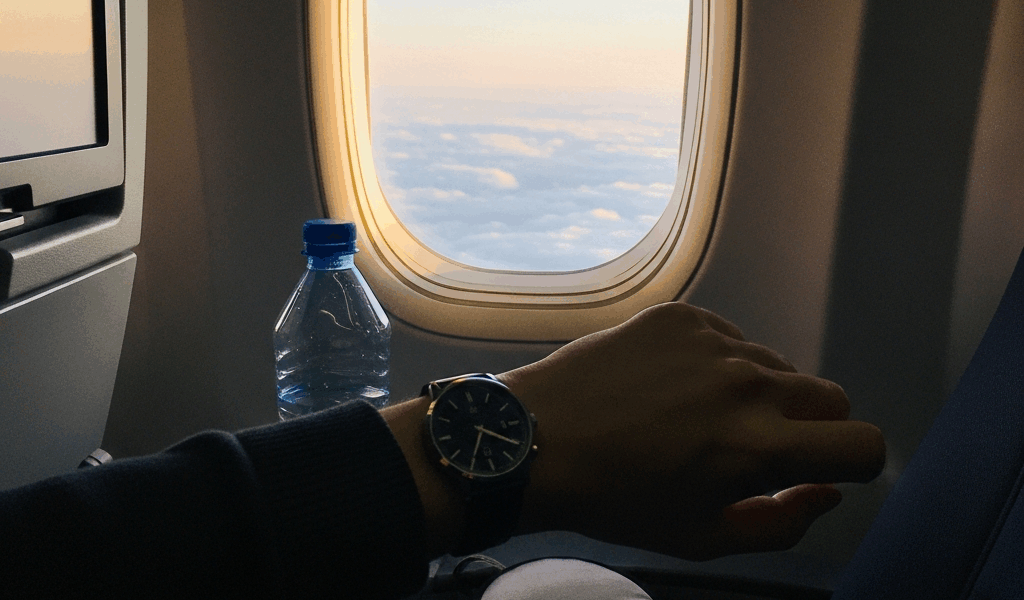
Set your watch — or your phone display — to destination time the moment you sit down. Not at takeoff. Not somewhere over the Atlantic. Right away, before the door closes. Your brain responds to timekeeping cues more than most people realize. Glancing at your watch and seeing your new timezone unconsciously starts adjusting your expectations around meals, light exposure, and sleep. Takes maybe 15 minutes before your brain genuinely accepts the shift. It sounds like superstition. It isn’t.
Use the window shade deliberately, not as a blackout tool. Flying east and need to arrive alert? Open the shade as you approach your destination’s morning. Arriving into daylight? Keep it open. Arriving at night? Leave it closed until you touch down. Light exposure is the second-most-powerful circadian reset available — second only to physical movement. Your eyes transmit signals directly to your brain’s master clock through a dedicated neural pathway. Darkness says sleep. Light says wake. Use that mechanism on purpose rather than defaulting to whatever feels comfortable.
Sleep timing on the plane depends entirely on when you land. Landing in the morning? Cap your sleep at 90 minutes regardless of how exhausted you feel. Your goal is to arrive genuinely tired so you’ll actually sleep that first night on local time. Landing at night? Sleep as much as possible. This inverts what most travelers do instinctively. Instinct says “I’m tired, let me sleep.” Strategy says “Will this sleep move my clock toward my destination?” Those are different questions with different answers depending on your itinerary.
Probably should have opened with this section, honestly — but avoid sleeping pills on shorter flights, anything under eight hours. Ambien and similar prescription aids can leave you foggy during a connection, which creates real problems. Melatonin works, but dosage matters more than most travelers know. I’m apparently a 0.5mg person and the Natrol low-dose tablets work for me while the 10mg gummies marketed everywhere never actually helped me sleep — they just left me groggy. Take 0.5 to 3mg about 30 minutes before your target sleep window, and only if you have at least six uninterrupted hours ahead. Dosing yourself and waking up in three hours for a connection is a disaster.
How to Reset Your Body Clock After You Land
Get outside within 30 minutes of landing. Sunlight runs 5,000 to 10,000 lux depending on cloud cover and time of day. Your hotel room is probably 300 lux on a good day. That intensity gap triggers a cascade of hormonal adjustments — cortisol, serotonin, melatonin suppression — that starts pulling your clock toward local time. Wear sunglasses if the glare is harsh. Get the exposure anyway. Even 20 minutes outdoors resets your clock more effectively than eight hours in a darkened hotel room.
Take a short walk instead of collapsing the moment you check in. Fifteen to twenty minutes at a comfortable pace — no gym session, no aggressive workout, just movement outside in natural light. This stacks three reset mechanisms simultaneously: light exposure, physical movement, and behavioral anchoring. Your body starts learning “we’re here now; time to adjust.” That was the single biggest shift in my post-flight recovery, more than any supplement or sleep strategy I’ve tried.
Eat on your destination’s meal schedule starting from your first meal after landing. Skip the in-flight “breakfast” service if it’s 3 a.m. at your destination. Wait and eat a proper breakfast when morning actually arrives where you are. Food is a circadian cue — your digestive system expects meals at predictable intervals. Eating on local schedule signals to your gut and your brain that the timezone has shifted. Most travelers completely ignore this and then wonder why their recovery takes an extra day.
The 20-minute nap cap is real, and it’s uncomfortable to follow. You will want to sleep the moment your head touches the hotel pillow. Set a phone alarm — I use the Bedtime feature on iOS with the volume cranked — lie down, and get up when it goes off. Anything longer than 20 minutes pushes you into deep sleep stages and you’ll wake up feeling genuinely worse than before. Twenty minutes hits the sweet spot. Enough to reduce acute sleep debt without triggering that heavy, disoriented grogginess. Do it anyway even when every instinct tells you to just stay horizontal.
No naps after 3 p.m. on day one. This protects your first night’s sleep, which is the anchor point for your entire circadian reset. A 4 p.m. nap means lying awake at midnight staring at a ceiling in a Marriott somewhere. Stay uncomfortable through the late afternoon. It’s temporary — and it pays off by morning two.
Mistakes That Make Jet Lag Worse Than It Has to Be
Drinking on the plane. Alcohol metabolizes in one to two hours and then triggers a rebound wakefulness that fragments your sleep into useless two-to-three-hour chunks. You feel like you slept. You didn’t — not in any restorative sense. You passed out twice with significant wakefulness between. Skip it entirely on eastbound flights especially.
Pulling the blackout curtains closed your first morning. This is the mistake I see most often — and I made it myself for years. You land exhausted, you want darkness, you seal the room. Now it’s 10 a.m. local time and your brain has zero external time cue. It holds onto your departure timezone for another half day. Light exposure breaks that hold. Open the curtains. Sit near the window. Let your eyes do the work they’re designed to do.
Skipping breakfast on day one. Fasting that first destination morning delays your circadian reset by four to six hours, according to chronobiology research out of the Salk Institute. Food isn’t just fuel — it’s a time signal to your entire digestive and hormonal system. Eat something within two hours of waking, even if your appetite hasn’t caught up yet. A bowl of oatmeal and a coffee at 7 a.m. local time sends a cleaner reset signal than waiting until hunger finally arrives at noon.
Intense exercise in the afternoon on day one. Afternoon workouts suppress melatonin production and push your sleep window later — the opposite of what you need when you’re trying to consolidate early sleep on local time. Save the gym session for day two or three. A short walk is fine. A 90-minute CrossFit class at 4 p.m. local time is not.
Assuming you’ll adapt faster on your second or third trip to the same destination. Your circadian system doesn’t learn routes. Every new long-haul requires the same reset protocol from scratch. The flights don’t get easier through repetition — your expectations shift, maybe, but your physiology doesn’t change. Treat each long-haul like your first one, follow the same protocol, and you’ll recover in roughly the same window every time. Skip the protocol because you’ve done the route before and you’ll pay for it on day two.



Leave a Reply