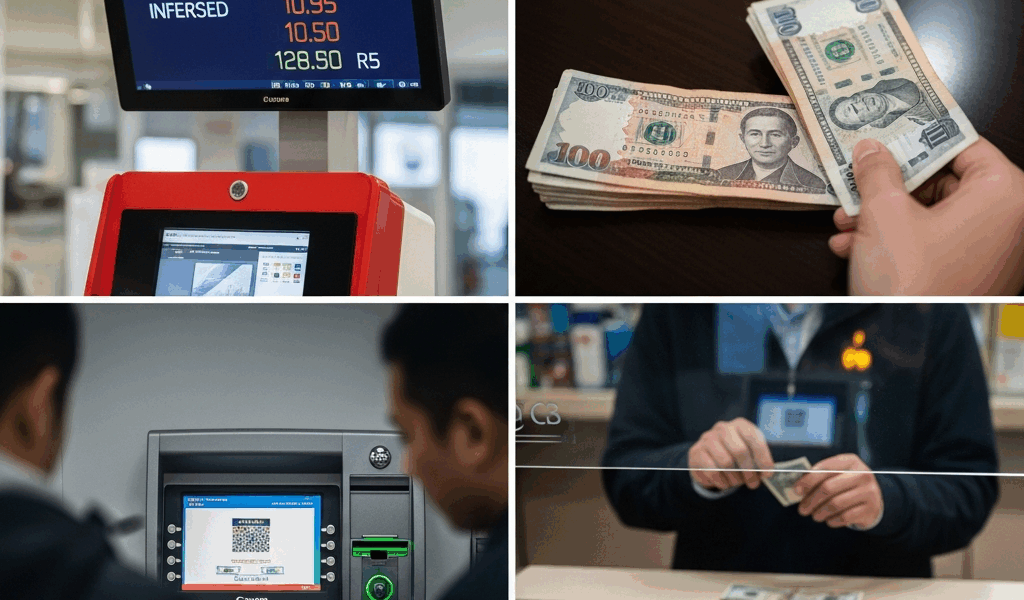
Currency Exchange Has Gotten Complicated With All the Tourist Traps Flying Around
As someone who has handed money to airport kiosks, hotel front desks, and sketchy street booths across four continents, I learned everything there is to know about getting fleeced at the exchange counter. Today, I will share it all with you.
But what is the spread? In essence, it’s the gap between the mid-market rate — the real rate banks use among themselves — and whatever inflated number gets quoted to you at a booth. But it’s much more than that. It’s the mechanism behind nearly every bad deal travelers unknowingly accept every single day.
Here’s what it looks like in actual dollars. Mid-market rate: 1 USD = 0.92 EUR. A decent exchange gets you close to that. An airport kiosk? You’re walking away with 1 USD = 0.87 EUR. On a $500 exchange, that 5% gap costs you roughly €25 — gone before you’ve even found your luggage. That’s dinner in Rome. Two Uffizi tickets. A full tank somewhere in rural France.
Most travelers have no idea what the mid-market rate is when they’re standing at a kiosk, jet-lagged, carry-on in one hand, just trying to get local cash fast. They hand over their bills. The kiosk wins. So, without further ado, let’s dive in — worst options first, smartest last.
The Worst Places to Exchange Money — And How Bad It Actually Gets
Airport Currency Kiosks
Airport kiosks are the worst. Full stop. Markups typically run 8–15% above mid-market, and their entire business model depends on your desperation. You’re trapped — luggage, exhaustion, and zero alternatives in sight. They know it. A $500 exchange at a 10% markup is $50 transferred directly out of your vacation budget. That’s not a fee. That’s a penalty for being in a hurry.
Hotel Front Desk Exchanges
Hotel desks usually land somewhere between 7–12% above mid-market. What makes them sneakier than airport kiosks is the pitch. “No commission,” they’ll say, smiling. Then they quote you a rate that’s 10% off reality. I learned this the hard way in Barcelona — exchanged €100 at the front desk of a perfectly nice hotel, pulled up XE.com later that night, and realized I’d paid roughly $15 extra for the convenience of not walking two blocks. Don’t make my mistake.
Cruise Ship Exchanges
Trapped on a boat with nowhere else to go? The markups reflect that — 12–18%, sometimes worse. These are genuinely among the worst rates you’ll find anywhere outside of outright fraud. Bring cash aboard or sort it at the port before you sail.
Street Exchangers and Tourist-Area Booths
Wildly inconsistent. Some are actually fine. Many hit you with 10–15% markups, and a few will straight-up switch bills on you mid-transaction. The unpredictability is itself the problem — you can’t benchmark a street booth in real time while someone’s counting out notes at you. That’s what makes them dangerous to anyone who doesn’t already know the going rate cold.
The Smartest Way to Get Local Cash in Most Countries
Use a local ATM with a fee-free travel debit card.
Honestly, that’s the whole answer for most destinations. Cards like the Charles Schwab Investor Checking account, Wise, or Revolut carry no foreign transaction fees and refund or waive ATM charges even abroad. You pull local currency at or within 0.5% of the true mid-market rate. The ATM operator might tack on a flat charge — usually $2–4 USD equivalent — but that’s a known, fixed cost. It’s nothing compared to a percentage-based markup on a large exchange.
Pre-ordering from your bank sounds smart. It usually isn’t. Your bank locks in a rate days before you travel. Rates move. You’re betting on where they’ll land — and the house always has better odds. An ATM gives you the rate on the exact day you need cash. Plus, you’re not walking through customs or climbing into a taxi with $800 in your jacket pocket.
One thing I’m apparently bad at remembering every single trip: the dynamic currency conversion trap. Use an ATM abroad and it will ask whether you want the charge converted to USD or processed in local currency. Always choose local currency. I’m apparently the kind of person who reads fast and almost taps the wrong button — and Schwab works for me while dynamic conversion never does. The rates they offer on that screen run 5–10% worse than your bank’s conversion. Just hit “no.” Every time.
ATMs aren’t always the answer, though. Countries with capital controls — Argentina comes to mind, Venezuela too — have official ATM rates that are artificially bad or simply unavailable. Rural areas in parts of Southeast Asia, East Africa, and Central America can go hours between working machines. In those cases, you fall back to the next tier.
When You Actually Need Cash Before You Land
Probably should have opened with this section, honestly.
Sometimes you land at midnight. The ATMs in the arrivals hall are out of service or charge $8 a pop. You need a taxi. The driver does not take cards. Pre-trip exchange makes sense in exactly this scenario — but most people do it wrong.
They order $500 for a week-long trip because anxiety. They end up with a fistful of leftover euros converting back at an even worse rate at the return terminal. Frustrating every single time.
Order only what you need for the first 24 hours. That’s probably $50–100 equivalent. Covers a taxi, a meal, and one or two unexpected expenses. After that, find an ATM.
Your bank is actually reasonable here — mid-market rate plus roughly 2–3% total. Order a week before departure so they have the currency in stock. Credit unions sometimes beat banks on this. Wise offers delivery, solid if you have 3–5 days. Revolut can issue foreign cash too, though rates vary by country.
Never order at the airport. You’re panicking, you’re exhausted, and you will pay the penalty rate for both of those things simultaneously.
How to Check If You Got a Fair Rate in Under 30 Seconds
Pulled $200 from an ATM in Bangkok and received 6,800 Thai baht? Here’s the audit.
Open Google. Search “USD to THB.” Mid-market comes back at 1 USD = 34.2 THB. At that rate, $200 should have gotten you 6,840 baht. You got 6,800. That’s 40 baht difference — roughly 0.6%. Factor in a $2–3 ATM fee. This was a fair transaction. Close your phone and go find street food.
XE.com works the same way. Plug in what you exchanged, compare to mid-market, calculate the gap, convert that gap back to your home currency. That number — whatever it is — is your real cost. When it shows 5% or more with no visible ATM fee on the receipt, you were hit with a bad rate. That’s the number to remember next time you’re standing at a booth deciding whether to hand over your cash.
That’s what makes this 30-second check so endearing to us frequent travelers — it turns every exchange into something you can actually evaluate instead of just hoping for the best. One last thing before you go: check your travel card’s foreign transaction fee policy before departure. Some cards charge 1–3% on top of the conversion and bury it in the statement. A card with zero foreign transaction fees plus a sensible ATM withdrawal beats every other option on this list. That combination is genuinely unbeatable.


Leave a Reply