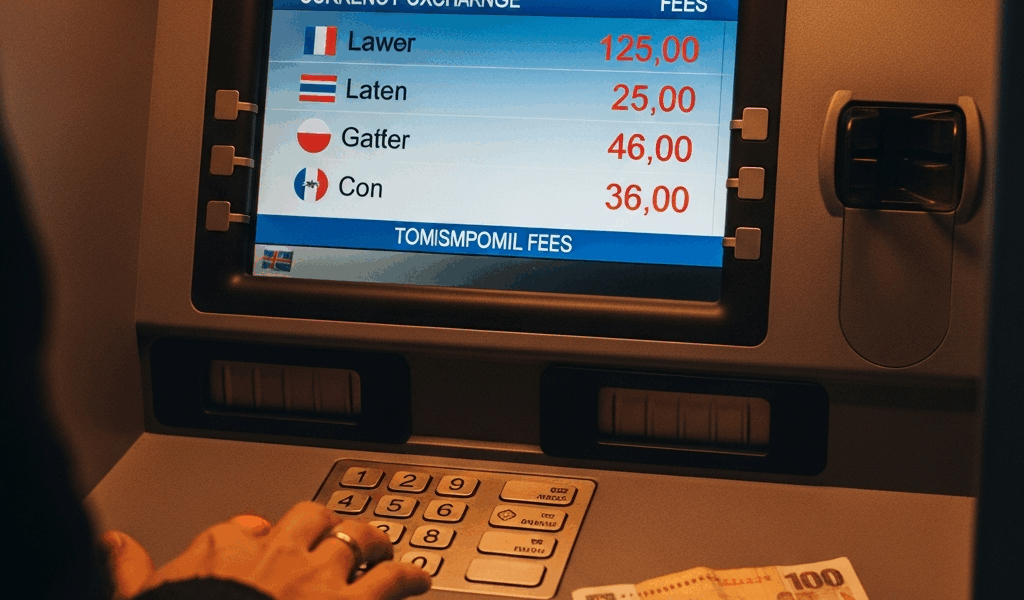
Why ATM Fees Stack Up Faster Than You Think
ATM fees abroad have gotten complicated with all the confusing fine print and sneaky surcharges flying around. As someone who lost roughly $180 across three international trips — Barcelona, Rome, Bangkok — I learned everything there is to know about avoiding ATM fees the hard way. Today, I will share it all with you.
Most travelers treat an ATM withdrawal like a single transaction. One fee. Done. That’s the mistake. Here’s what actually happens when you pull 200 euros from a random machine in Europe. Your home bank clips you with a foreign transaction fee — typically 1–3 percent. The ATM operator, often a private network like Euronet rather than an actual bank, tacks on a surcharge of $2–4. Then there’s dynamic currency conversion, which we’ll get to in a minute. That single 200-euro withdrawal ($216 USD at mid-market rates) bleeds out across three invisible layers before you even pocket the cash.
Let me show you the math.
- Original withdrawal: 200 EUR = $216 USD (mid-market rate)
- Home bank foreign transaction fee (2%): –$4.32
- ATM operator surcharge: –$3.00
- Dynamic currency conversion markup (5%): –$10.80
- Your actual cost: $234.12
- Real dollars spent on a $216 withdrawal: $18 extra
Over a 10-day trip with three withdrawals, that’s $54 in pure waste. Probably should have opened with this section, honestly. Nobody feels the sting of a $3 fee. They feel the sting of three fees stacked into an $18 surprise they never anticipated.
Always Decline the ATM’s Currency Conversion Offer
This is the one. If you ignore everything else in this article, lock this in: when the ATM screen asks whether you want the charge in your home currency or local currency, you say no to your home currency. Every single time. No exceptions.
The machine will phrase it something like — “Convert to USD now at a rate of 1 EUR = 1.09 USD?” or “Complete transaction in dollars?” The exact wording shifts depending on the country and ATM network. But the offer is always the same. It’s always bad.
But what is dynamic currency conversion? In essence, it’s the ATM operator pre-converting your withdrawal at their own inflated exchange rate instead of letting your bank handle it. But it’s much more than that — it’s a deliberate design to make you feel like you’re getting a convenience when you’re actually paying a premium for a worse deal. Your bank’s rate tracks close to the mid-market rate, what you’d see on XE.com or Google right now. The ATM’s rate runs 3–7 percent worse. That $216 withdrawal becomes $231 before your bank even sees the transaction.
The screen language is engineered to confuse. “Guaranteed rate” sounds like protection. “Convert now” sounds like efficiency. You’re not getting either. Decline it. Let the transaction post in local currency. Let your bank convert at their standard rate — it will almost always be cheaper.
I watched a guy in Prague take the bait because the machine flashed “guaranteed rate of 1 USD = 21.5 CZK.” The mid-market rate that day was 1 USD = 23.2 CZK. He lost roughly $40 on a single 5,000-koruna withdrawal because he trusted a machine over common sense. Don’t make my mistake.
The Best Bank Accounts That Reimburse ATM Fees
While you won’t need to open six different accounts, you will need a handful of the right ones. First, you should look at Charles Schwab High-Yield Investor Checking — at least if you have investable assets or can maintain the $25,000 minimum balance for the investor checking tier. Schwab might be the best option, as international travel requires zero-fee withdrawals worldwide. That is because Schwab reimburses all ATM operator surcharges at the end of each month, regardless of which machine you used or which country you were standing in. No foreign transaction fees either. A 10-day Europe trip with three $300 withdrawals will run you around $35 in combined surcharges — Schwab hands it back at month-end.
Wise (formerly TransferWise) works differently. You load it with USD before you leave home. It’s a borderless debit card holding 40+ currencies, converting at mid-market rates with no markup. The first two ATM withdrawals per month are completely free. After that, you’re looking at roughly 2 percent per transaction. For a two-week trip with three withdrawals, Wise costs you nothing. I’m apparently a chronic over-withdrawer and Wise works for me on shorter trips while my traditional Chase account never saves me a dime internationally.
Revolut’s free tier covers one ATM withdrawal per 30-day period. Additional withdrawals run 2 percent of the amount. Real exchange rates, 150+ countries. The catch — and it matters — is a $500 monthly ATM withdrawal ceiling on the free tier. Need $1,200 over a month? You’ll hit that ceiling and start paying fees around withdrawal three or four.
Here’s the practical breakdown. Three $300 withdrawals over 10 days: Schwab (fully reimbursed) and Wise (two free, one at 2%) are your best plays. Four withdrawals over three weeks: Wise runs you roughly $12 in fees on withdrawals three and four, versus $40–50 on a standard bank account. That’s what makes these accounts endearing to us frequent travelers — the math works even when you’re not perfect.
How to Find ATMs That Don’t Charge Operator Fees
Not every ATM charges a surcharge. Bank-branded machines operated by the institution itself — a Banco Santander in Spain, an ING machine in Warsaw, a National Bank of Greece ATM in Athens — typically skip the operator fee entirely. You’ll still face your home bank’s foreign transaction fee and the ever-present DCC screen, but you sidestep that $3–4 surcharge that compounds across a full trip.
Tourist zones and airports are fee traps. Standalone machines in hotel lobbies, train stations, and anywhere near a major landmark run on the surcharge model — they know you need cash and you’re not shopping around. I hit a 4.50-euro surcharge at a machine in the Vienna airport, three meters from baggage claim. Nearly five dollars to walk slightly less far. That was embarrassing, honestly.
Before you land, pull up Google Maps and search for branch locations of major national banks at your destination. Banco del Bajío in Mexico City. Scotiabank across the Caribbean. BBVA in Spain and across South America. Screenshot the locations or save them offline — cellular data abroad adds up fast and you don’t want to be burning through a roaming plan just to find a free ATM.
Withdraw larger amounts less often. A single 800-euro withdrawal beats four 200-euro withdrawals every time. One surcharge. One foreign transaction fee. The tradeoff is carrying more cash — use a hotel safe or a travel backpack with a hidden interior pocket, something like the Pacsafe Venturesafe 25L.
ATM safety matters here too. Stick to machines attached to physical bank branches, preferably during daylight hours. Standalone kiosks in dim train stations at midnight are not worth the convenience. No fee savings justifies a robbery.
What to Do If You Got Charged Anyway
Mistakes happen. You’ll accidentally tap “convert to home currency” and realize it three hours later over dinner. Or a machine will ding you with a surcharge that was never displayed on screen. So, without further ado, let’s dive into damage control.
Call your home bank’s customer service line. Some banks — not all, but enough — will reverse a single foreign transaction fee if you explain the situation clearly and it’s your first complaint. They won’t do it twice, but once per trip you have a legitimate shot. Revolut and Wise handle disputes faster; you file directly through the app and usually hear back within 48 hours.
If a machine charged a surcharge it never disclosed, file a dispute with the ATM operator’s customer service line. Success rates are low. But if the machine malfunctioned or skipped the required fee disclosure screen — which is legally mandated in most countries — the operator will sometimes issue a refund just to avoid the paperwork of a formal complaint.
Pre-trip checklist:
- Notify your bank of travel dates and destinations before you leave
- Activate your fee-free card — Schwab, Wise, or Revolut, depending on trip length
- Screenshot fee-free ATM locations at your destination while you’re still on home WiFi
- Memorize this: decline DCC every single time, no exceptions
- Plan your withdrawal amounts and frequency before you land
That’s it. You won’t zero out every charge — your home bank’s foreign transaction fee might still apply depending on the account. But you’ll cut total ATM costs by 60–80 percent over a typical two-week trip. The difference between losing $50 and losing $10. Over five or six international trips, that math starts to feel significant.



Leave a Reply