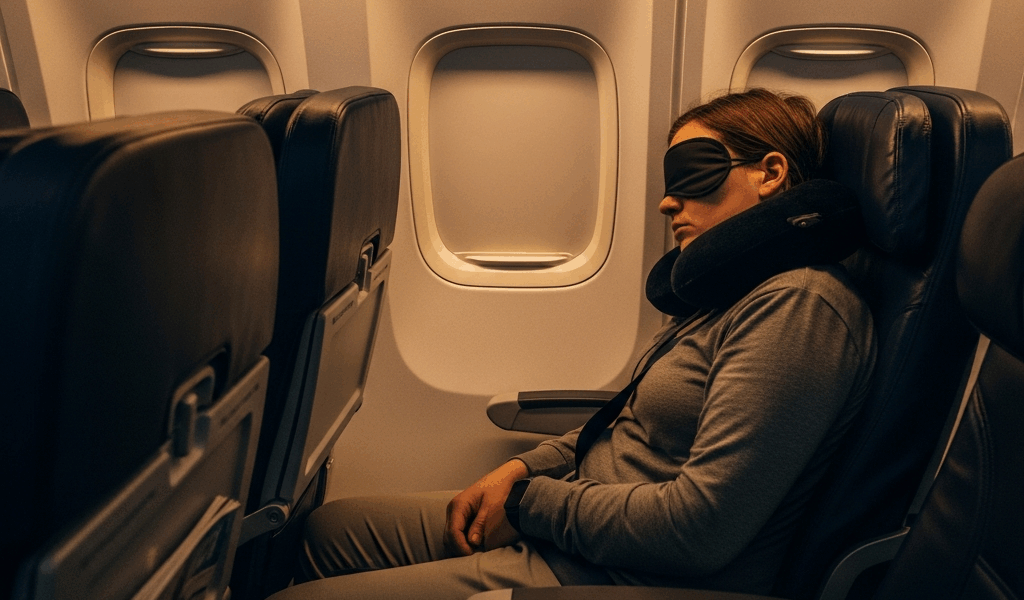
You are wedged into a 31-inch pitch economy seat for the next nine hours, and the overhead reading light from the guy in 22F is aimed directly at your face. The baby three rows back started crying somewhere over the Atlantic and has not stopped. Your neck pillow keeps deflating. You already know the generic advice — get a window seat, wear earplugs, take melatonin. Here is what actually works when you are dealing with the real conditions of economy class and not the sanitized version from someone who last flew coach in 2019.
Pick the Right Seat Before Anything Else
Window seat. Always. For sleeping, the window is nonnegotiable. You get a wall to lean against, nobody climbs over you to use the bathroom at 2 AM, and you control the window shade. Aisle seats give legroom but you will be bumped by every passenger and drink cart that passes.
Avoid the last row — those seats often do not recline. Avoid rows near the lavatories — constant foot traffic, the lock clicking, the flush sound, and the light every time the door opens. Avoid seats directly in front of the exit row — those seats cannot recline either because the exit row needs the space.
Check SeatGuru.com or the SeatMaestro app before you book. Plug in your flight number and it shows you the exact aircraft layout with color-coded seats — green for good, yellow for caution, red for avoid. Five minutes of research here saves you eight hours of regret. Specific thing to watch for: some economy seats on wide-body aircraft have misaligned windows, so you pick a “window seat” and the window is actually behind your shoulder. SeatGuru flags this.
One counterintuitive tip: exit row seats have more legroom but the armrests are fixed and cannot be raised. If you sleep by curling sideways across two seats on a less-full flight, exit rows make that impossible. For pure sleeping purposes, a regular window seat in a quiet section beats an exit row every time.
The Gear That Actually Works
Forget the standard horseshoe neck pillow. It lets your head fall forward, which wakes you up every time you doze off. Two options that actually hold your head in position: the Trtl pillow, which is a fabric-wrapped internal support that holds your head at an angle against the window, or an inflatable pillow with a chin support shelf that prevents the forward nod. Both run $25 to $35 and both are dramatically better than the horseshoe for actual sleeping.
Eye mask matters more than you think. A flat cloth mask lets light leak in around the nose bridge, and the pressure on your eyelids makes REM sleep harder. A contoured mask — Manta Sleep is the gold standard at about $30 — has molded cups that sit off your eyelids entirely. You can blink with your eyes open inside the mask in total darkness. The difference in sleep quality is noticeable.
For sound: foam earplugs alone are not enough on a long-haul flight. Layer them with noise-canceling earbuds running a white noise app. The earplugs kill the high-frequency sounds (babies, announcements, that overhead light click), and the earbuds mask the low-frequency engine drone that earplugs cannot fully block. This combination gets you closer to silence than either one alone.
The sleeper hit (literally): a footrest hammock. It is a small fabric sling that hooks onto the tray table lock of the seat in front of you, letting you elevate your feet 6 to 8 inches off the floor. Costs about $12 on Amazon. It reduces leg swelling, takes pressure off your lower back, and makes the seat feel dramatically more comfortable. Pair it with compression socks and your legs will feel almost normal after a 10-hour flight.
What to Do Before the Flight
Cut caffeine at least 6 hours before your planned sleep time on the plane. If your flight departs at 7 PM and you want to sleep by 9 PM, your last coffee is 3 PM at the latest. Caffeine has a half-life of about 5 hours — even if you think you are immune, it is sabotaging your ability to fall asleep at altitude.
Exercise during the day of the flight. A 30-minute run, a gym session, even a long walk through the airport terminal before boarding. Physical fatigue helps override the discomfort of the seat and the stimulation of the cabin environment. Your body wants to sleep more when it is genuinely tired, not just bored.
Eat a proper meal at the airport before boarding. Do not rely on plane food timing to align with your sleep schedule — the meal service on a 9 PM departure might not start until 10:30 PM, which means bright cabin lights, tray tables, and activity right when you want to be unconscious. Eat beforehand, board full, and you can skip the meal service entirely.
Melatonin works, but dosage matters. Most people take too much. Research suggests 0.5 to 3 mg is the effective range — more than that does not help you sleep faster and can leave you groggy. Take it 30 minutes before your target sleep time. Set your phone to the destination time zone as soon as you board so you start adjusting mentally.
In-Flight Sleep Strategy
If the flight offers a meal service shortly after takeoff, eat if you are hungry, then recline your seat immediately after the trays are collected. Waiting means the person behind you is settled and asleep, and reclining into a sleeping passenger creates conflict. Recline early while everyone is still adjusting.
Keep your seatbelt fastened and visible over your blanket. If turbulence hits during the night and the seatbelt sign comes on, the flight attendants walk through and wake up every passenger whose belt they cannot see. One small buckle adjustment saves you from being shaken awake at 3 AM.
The best sleeping position in economy with a window seat: lean your head and shoulder toward the window, wedge your pillow between your head and the wall, and angle your body slightly toward the window. Feet go on the footrest hammock or on top of your underseat carry-on bag to elevate them a few inches. One earbud in playing white noise or brown noise — leave the other ear open so you can hear safety announcements without the volume that keeps you alert.
Keep the seatback screen off. The blue light from those screens suppresses melatonin production and keeps your brain in awake mode. If the screen does not turn off fully and stays on a dim standby, drape your eye mask so the light is blocked from your peripheral vision.
When You Cannot Sleep
If you have been lying there for 30 minutes and sleep is not coming, stop trying. Forcing it makes insomnia worse — your brain associates the effort with stress, which is the opposite of what you need. Get up, walk to the galley area, stretch your legs, and drink some water. Then come back and try again.
Put on a movie you have already seen. Familiar content does not engage your brain the way new content does — it provides enough distraction to stop the anxiety spiral without the stimulation that keeps you wired. Alternatively, a guided meditation app (Headspace has a specific sleep section) gives your brain something to follow without requiring alertness.
Do not check the flight tracker obsessively. Watching the remaining hours tick down makes every minute feel longer. Close the app, close the screen, and accept that even lying still with your eyes closed provides meaningful rest. Studies show that quiet rest without actual sleep still reduces fatigue and improves cognitive function compared to staying active and stimulated. On any flight over 8 hours, even 3 hours of real sleep mixed with quiet rest is a win. Perfection is not the goal — functional arrival is.



Leave a Reply