Why You Can’t Sleep on Planes — And What’s Actually Happening to Your Body
Sleeping on planes has gotten complicated with all the bad advice flying around. Take melatonin. Drink wine. Buy a neck pillow. None of it works the way people claim, and most travelers spend twelve hours to Tokyo staring at the seatback map wondering why they can’t drift off.
As someone who spent three years flying transatlantic routes for work, I learned everything there is to know about in-flight sleep. Today, I will share it all with you.
Here’s the short version: you’re not bad at sleeping. Your body is just fighting six separate physiological battles at once. Cabin pressure hovers at the equivalent of 6,000 to 8,000 feet altitude — enough to drop blood oxygen saturation and nudge your nervous system into mild hypervigilance. The air runs at 10 to 20 percent humidity. Your home sits closer to 30 to 65 percent, so your mucous membranes dry out fast, causing micro-awakenings you don’t even register as waking. Engine noise isn’t a steady hum either; it’s a constant 85-decibel wall with harmonic peaks that specifically aggravate the auditory nerve. Overhead panels and seatback screens blast artificial light, suppressing melatonin and convincing your brain it’s noon. Cortisol spikes from the low-grade anxiety of being 35,000 feet over open ocean with nowhere to go. And then there’s the middle seat — pinched between an armrest and a stranger — wrecking any chance at the spinal alignment your body needs for deep sleep.
But what is the actual problem here? In essence, it’s a mechanical one. But it’s much more than that — it’s six mechanical problems happening simultaneously, which is why single fixes fail. That’s what makes troubleshooting in-flight sleep so frustrating to the average traveler. So, without further ado, let’s dive in.
Pick the Right Seat Before the Flight Even Starts
Window seat. Full stop.
Not for the view — for the wall. You get a hard surface to lean against without cranking your head sideways for eight hours. You control the shade, which means you control light exposure. Nobody climbs over you at 3 a.m. The only downside is bathroom access, and I’ll cover how to make that a non-issue in the hydration section.
Avoid the rows directly above the wing and just aft of the engines. That’s where vibration concentrates. On a Boeing 777, rows 25 through 35 sit over the engine nacelles. On an Airbus A350, it’s rows 22 to 32. These rows show up cheap on booking sites for a reason. Front-third seating — roughly rows 8 to 15 depending on configuration — sits forward of peak vibration and stays noticeably quieter.
Middle seats are sleep killers. No wall, no armrest stability, hips compressed between two strangers. If you get assigned one, call the check-in counter three hours before departure. Gate agents will often move you to a window or aisle seat if inventory exists. Don’t make my mistake — I assumed nothing was available on a London to Houston flight and spent eleven hours in 34B. There were four open window seats.
Use SeatGuru before you book. Plug in your flight number and aircraft type. The site flags which seats carry engine noise problems, limited recline, or proximity to lavatories and galleys. Thirty seconds of checking. The difference between row 12 window and row 28 middle is the difference between four hours of sleep and zero.
The Day Before and During Boarding
Probably should have opened with this section, honestly — because seat selection means nothing if your body isn’t prepared when boarding starts.
Most people treat the night before a flight like any other night. That’s the first mistake.
If your flight departs at 8 p.m., go to bed ninety minutes earlier than usual the night before. You’re building a two-to-three hour sleep debt — enough to fall asleep quickly once you’re airborne, but not so much that you’re past the point of actual rest. It sounds counterintuitive. Most people assume more tiredness means faster sleep. It does, to a point. Past that point, you’re running on cortisol and can’t fall asleep regardless of how exhausted you feel.
Alcohol. I learned this lesson on a 12-hour flight to Sydney — the bar cart looked like salvation somewhere over the Pacific. It isn’t. Alcohol knocks you out initially, then destroys REM sleep and fragments everything that follows. You wake up four times instead of once. On a plane already working against you with pressure changes and noise, a couple of drinks cuts effective sleep quality in half. Skip it entirely.
Hydration works backward from what most people expect. Drink aggressively for three days before the flight — not during. Pre-loading your cells buffers against the dehydrating cabin environment. On the flight itself, drink 250 milliliters of water every two hours, then cut off fluids ninety minutes before your target sleep window. Your bladder stays quiet. The diuretic rebound that causes nighttime bathroom runs gets neutralized.
Eat your last real meal six to eight hours before your target sleep time. A 2 p.m. meal before an 8 p.m. departure works well. Digestion actively interferes with sleep onset — your body doesn’t multitask those processes efficiently. During boarding, eat something small. A banana. A handful of almonds. Those arrival meals flight attendants bring around at midnight local time? Skip them. Eat after landing.
During the boarding hour, do two things. Walk the terminal for ten minutes — movement depletes glycogen and primes your muscles for recovery sleep. Then drop your phone and e-reader brightness to around 15 percent for thirty minutes. Your pineal gland starts producing melatonin before the cabin lights even dim.
The Gear That Actually Helps — And What to Skip
While you won’t need to spend $1,000 on sleep gear, you will need a handful of specific items that address the actual physiological problems, not the imaginary ones.
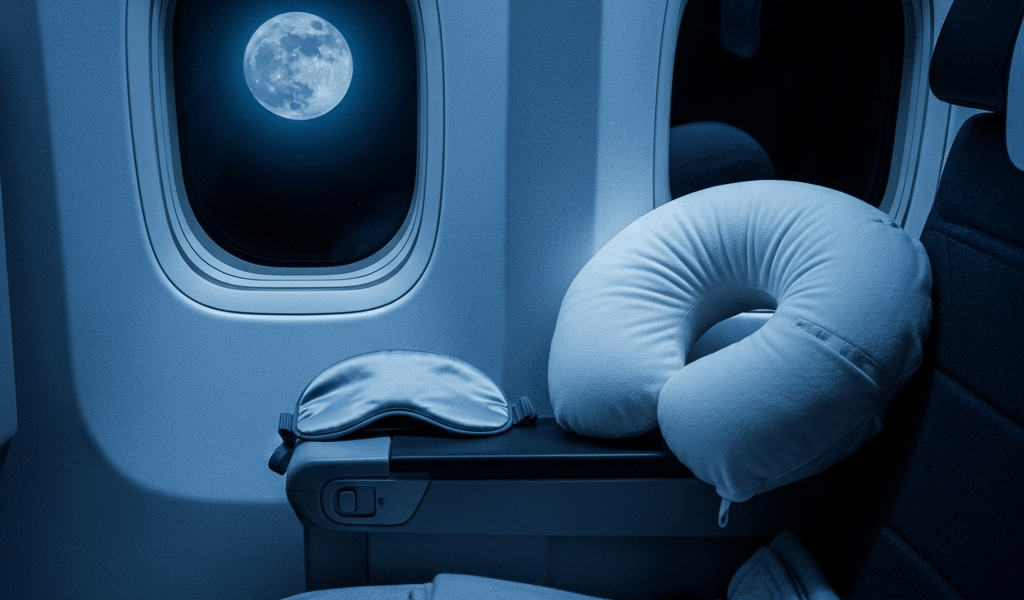
First, ditch the U-shaped neck pillow — at least if you want to actually sleep. The standard foam horseshoe props your chin forward and creates neck strain within two hours. Bring a small rectangular pillow instead, roughly 12 by 16 inches, positioned between your head and the window wall. Solid foam, not memory foam. Memory foam traps heat and turns clammy around hour three.
Noise-cancelling headphones might be the best option, as in-flight sleep requires blocking frequencies around 500 Hz — that’s engine rumble territory. That is because most earbud-style cancellation misses that range entirely. Over-ear headphones with active noise cancellation are worth the investment. The Sony WH-1000XM5 runs $380 and flattens engine noise by 25 to 30 decibels. The Anker Soundcore Space A40 at $100 covers about 60 percent of that performance and hits the frequency range that matters most. I’m apparently sensitive to high-frequency cabin harmonics and the Anker works for me while cheaper earbuds never came close. Pair either with brown noise through Noisli or a basic YouTube track. Not music, not podcasts — both trigger pattern recognition in your brain and actively prevent sleep.
An eye mask matters more than most people realize. Get one with contoured padding that sits against the eye socket without pressing on your eyelids directly. The Manta Sleep mask runs $40 and uses cup-shaped padding instead of flat fabric. Worth it if you fly more than twice a year. Light leaking through the edges of a flat mask is what actually wakes you — not ambient brightness in the cabin.
Compression socks, 15 to 20 mmHg rating, reduce DVT risk on flights over six hours and cut the restlessness caused by fluid pooling in your lower legs. Sockwell makes a reliable pair at around $20. They feel odd for thirty minutes. Then you forget they exist. Restless legs kill in-flight sleep faster than almost anything else on this list.
Melatonin works — but the dosage most stores sell is wrong. Take 0.5 to 2 milligrams, not the 10 mg tablets sitting next to the checkout counter. Higher doses don’t work better. They just leave you groggy the following morning. Take it thirty minutes before your target sleep window, not at boarding.
What to Do When You Still Can’t Fall Asleep Mid-Flight
You’ve done everything right. Row 12 window. Melatonin timed correctly. Sony headphones running brown noise. Eye mask on. It’s been an hour and you’re still wide awake watching the flight path crawl across the Atlantic.
Get up.
Walk to the back galley. Do ten slow squats. Your leg muscles have been primed since boarding but haven’t discharged — movement drains the residual adrenaline keeping your system alert. Four minutes. Most people white-knuckle the armrests and wonder why the cortisol won’t drop.
Try box breathing. Inhale for four counts, hold four, exhale four, hold four. Repeat for five minutes. This isn’t meditation — it’s mechanical parasympathetic activation. It works regardless of whether you believe it will.
If ninety minutes pass without sleep, stop trying. This is the counterintuitive part. Shift your goal to “quiet rest” instead — eyes closed, attention on body sensation, no agenda. Sleep researchers call this state quiet wakefulness. It delivers roughly 40 to 50 percent of sleep’s restorative benefit. You’ll land less wrecked than you expect.
That was the single biggest shift for me, honestly — stopping the fight. A transpacific flight producing four hours of fragmented sleep is a genuine win. You’re not functional at landing because you feel rested. You’re functional because your body spent ten hours in a horizontal rest state, however imperfect.
The system works because it treats the problem as mechanical. You’re not trying harder to sleep. You’re removing the six specific obstacles that were preventing it.



Leave a Reply