How to Avoid Tourist Traps — What Locals Actually Recommend
Learning how to avoid tourist traps is one of those skills that sounds obvious until you’re sitting in a restaurant in Rome paying €22 for a plate of microwaved gnocchi while a man in a waiter’s apron tries to upsell you on a dessert that wasn’t on the menu. That was me, 2019, approximately 90 meters from the Trevi Fountain. The food was bad. The wine was worse. I tipped anyway because I felt guilty. I’ve since gotten better at this — not because I read a list somewhere, but because I’ve made enough mistakes across enough cities to recognize the patterns before they cost me money.
What follows isn’t a generic rundown. It’s the specific framework I actually use now, with the warning signs I wish someone had pointed out before I handed over money I didn’t need to spend.
The Five Warning Signs of a Tourist Trap Restaurant
The Rome experience taught me something useful — tourist trap restaurants don’t try to hide what they are. They’re just betting you won’t know what to look for. Once you see these signs, you can’t unsee them.
The laminated menu in six languages. A restaurant that caters to locals doesn’t need a menu in English, Mandarin, German, French, Spanish, and Japanese. Six languages means the entire business model is built around foot traffic from foreign visitors. That’s not inherently evil, but it’s a reliable signal that you’re about to overpay for something mediocre.
Photos of the food directly on the menu. Local restaurants in most of Europe, Southeast Asia, and Latin America don’t put photos on their menus. That’s a fast-food convention, adopted by tourist-facing restaurants because they know their customers won’t recognize dish names. If every item has a glossy photo next to it and the dishes look suspiciously like stock photography, walk away.
Someone standing outside recruiting you. This is universal. Paris, Bangkok, Cancun, Istanbul — if a person is stationed at the door saying “come in, come in, best pasta, good price” then the restaurant cannot fill its tables on its own merit. Good restaurants don’t need to do this. Full stop.
Location within 200 meters of a major landmark. This isn’t a rule without exceptions, but proximity to the Eiffel Tower, Sagrada Família, or Times Square is the single strongest predictor of inflated prices and underwhelming food. The rent is higher. The foot traffic is guaranteed. There’s no incentive to be good.
Identical menus on the same block. Walk down any tourist street in Barcelona’s Gothic Quarter and you’ll see five restaurants with the exact same paella, the exact same price points, and the exact same layout. Often they’re owned by the same person. The food comes from the same supplier. None of it is worth eating.
How to Find Where Locals Actually Eat
Probably should have opened with this section, honestly — because knowing what to avoid only gets you halfway there. You also need a strategy for finding the good stuff.
Filter Google Maps reviews by local language. This is the single most useful trick I’ve found. Open Google Maps, pull up reviews for any restaurant, and look for the option to filter by language. Switch to the local language — Spanish in Madrid, Japanese in Tokyo, Portuguese in Lisbon. If a restaurant has hundreds of reviews in Spanish and a handful in English, locals are eating there. That’s the signal. Reviews in only English or a mix of six tourist languages means what you’d expect it to means.
Walk two blocks from any landmark. Two blocks is usually enough to drop out of the tourist pricing zone. Not always four or five — just two. The restaurants that survive two blocks from the Pantheon in Rome without heavy foot traffic have to actually be good to stay open. I’ve eaten some of my best meals by doing nothing more than walking away from whatever I was supposed to be photographing.
Look for restaurants with no English menu. If the menu is only in the local language and there’s no picture-pointing option available, that’s a restaurant that has decided its customer base is local. That decision usually comes with better food and lower prices. Use Google Translate’s camera function if you need to — it’s worth the minor friction.
Lunch specials at business-district restaurants. This is genuinely underused. In most European and Latin American cities, restaurants in financial or office districts run a fixed-price lunch — called a menú del día in Spain, a formule in France — specifically to feed office workers on a budget. In Madrid I regularly ate a three-course lunch with wine for €11 doing this. These restaurants have zero interest in tourism. They’re feeding the same people every weekday and they need to be consistent and affordable to keep that trade.
Attraction Alternatives — Same Experience, Fewer Crowds
Burned by a two-hour queue for a museum that turned out to be half-closed for renovation, I started applying a simple framework before booking any attraction: what’s the second-best version of this experience, and what do I lose by choosing it?
Often the answer is: not much.
Lesser-Known Museums
Major cities cluster their museums. Madrid has the Prado, but it also has the Reina Sofía and the Thyssen-Bornemisza within a ten-minute walk — all three are world-class, and on any given Tuesday the Thyssen has a fraction of the Prado’s queue. Vienna’s Kunsthistorisches Museum is iconic, but the Belvedere has Klimt’s The Kiss and I’ve walked straight in without pre-booking three separate times.
Second-Tier Viewpoints
Every city with a famous viewpoint has a less famous one nearby. Montmartre in Paris is packed. The roof terrace of the Galeries Lafayette department store is free, has a nearly identical skyline view, and most visitors walk past the entrance without realizing it exists. In Istanbul, everyone goes to the Galata Tower. Çamlıca Hill on the Asian side has a better panorama, costs less, and has breathing room.
Neighborhood Markets vs. Central Markets
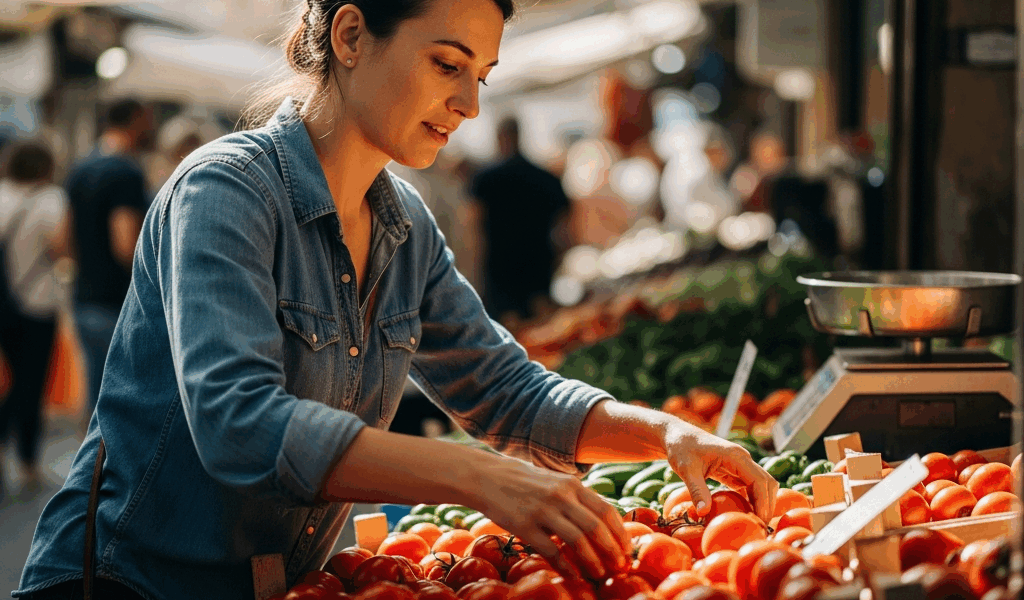
La Boqueria in Barcelona is a tourist attraction that happens to sell food. Mercat de l’Abaceria in Gràcia is a market. The difference is texture, price, and the fact that you can buy 400 grams of jamón for €6 without someone photographing their acai bowl next to you. In any city with a famous central market, ask your hotel staff which market the locals actually use for their weekly shopping. That’s the one worth visiting.
Shopping Traps and How to Avoid Overpaying
Airport retail operates on a specific logic — you’re captive, you’re often in a hurry, and you’ve already spent money so the psychological barrier is lower. Markups run between 30% and 100% over street price for the same item. The €14 bottle of olive oil in the Fiumicino airport costs €7.50 at any supermarket in Rome. If you want to buy local products, buy them before you get to the airport. Buy two.
Souvenir shops near landmarks follow a similar markup model. The miniature Eiffel Tower keychain that costs €5 at the base of the tower costs €1.50 at any tabac shop fifteen minutes away. Same item. Same manufacturer, almost certainly — which is to say, manufactured nowhere near France.
The more interesting trap is mistaking mass-produced goods for artisan work. If a market stall is selling fifty identical “handmade” ceramics, they’re not handmade. Genuine local artisans usually have a workshop you can visit, uneven glazing or stitching that reflects the hand rather than the machine, and a price point that reflects actual labor time. €8 for a “handwoven” scarf is not handwoven. €45 might be.
On negotiation — this is deeply regional. In Morocco’s medinas, haggling is expected and skipping it is culturally odd. In Japan, bargaining at a retail shop is rude. In Southeast Asian markets, gentle negotiation is standard; aggressive negotiation is not. Research the norm before you arrive rather than guessing. And when a fixed price looks high but comes with a written receipt and a clear return policy, it’s often fairer than the bargain that comes with neither.
When Tourist Experiences Are Actually Worth It
Here’s the thing nobody admits in these articles — sometimes the popular thing is popular because it’s genuinely extraordinary.
I’ve been cynical about mainstream attractions and missed things I later regretted skipping. The queues at the Uffizi in Florence are real and they’re long, and the Botticellis inside are some of the most staggering paintings I’ve ever stood in front of. No “lesser-known alternative” gives you that specific experience.
The framework I use now: if an attraction’s primary value is the thing itself — a specific work of art, a specific natural formation, a specific historical site — then no alternative replicates it and it’s worth whatever friction comes with it. If the attraction’s value is the type of experience — a viewpoint, a market, a food scene — then alternatives usually exist and often improve on the original.
The Sistine Chapel is worth the chaos. The Vatican gift shop is not. Santorini’s sunsets from Oia are genuinely beautiful; the €18 cocktail you buy to watch it from a bar terrace is optional. Separate the experience from the commercial apparatus built around it, decide which parts you actually want, and pay selectively. That’s the whole strategy, really — not avoidance, but clarity about what you’re actually buying.
The goal isn’t to travel like a local. You’re not a local. The goal is to spend your money on things that deserve it and recognize, before you open your wallet, which things those are.



Leave a Reply