You booked the ticket. The departure date is getting closer. And now the anxiety is creeping in because you have never actually done this before — walked through an airport alone, found a gate, boarded a plane, and arrived somewhere by yourself. The good news is that millions of people do this every single day, and the process is far less complicated than it looks from the outside. Here is exactly what happens, step by step, from your front door to your destination.
Before You Leave Home
Check in online 24 hours before your flight. Every major airline lets you do this through their app or website. Checking in early locks in your seat assignment and sometimes lets you snag a better seat if one opened up. Once checked in, screenshot your boarding pass — do not rely solely on the app loading at the airport. If your phone dies or the Wi-Fi is slow, that screenshot saves you from standing in the ticket counter line.
Pack your carry-on so that everything you need during the flight is accessible without digging. Phone, charger, earbuds, snacks, water bottle (empty — you fill it after security), ID, and boarding pass should all be within arm’s reach, not buried under a layer of rolled clothes. If you are checking a bag, keep a change of clothes in your carry-on. Bags get delayed sometimes, and having clean underwear and a toothbrush saves you from a miserable first night at your destination.
Set your alarm with a real buffer. For domestic flights, aim to arrive at the airport 2 hours before departure. International flights need 3 hours. These feel excessive until the one time the security line wraps around the terminal and you realize the buffer exists for a reason.
At the Airport — Check-In to Security
If you already checked in online, head straight to the security checkpoint. If you have a checked bag, stop at the bag drop counter first — most airlines have a dedicated line for passengers who already checked in online but need to drop luggage. This is usually faster than the full-service ticket counter.
Security is the part that intimidates most first-time flyers, but the process is straightforward once you know the sequence. Before you reach the front of the line, have your ID and boarding pass out and ready. When it is your turn, hand both to the TSA agent. They check the name matches, look at the boarding pass, and wave you through.
At the conveyor belt: take off your shoes, remove your laptop from your bag and place it flat in a separate bin, pull out your quart-size bag of liquids (anything liquid or gel over 3.4 ounces cannot go through — this is strict), and put your jacket and belt in a bin. Walk through the scanner with nothing in your pockets. Collect everything on the other side, put your shoes back on, and you are done. The whole process takes 2 to 15 minutes depending on the line. If something triggers additional screening, stay calm — they just wave a wand or pat down a specific area. It happens to everyone eventually and is not a big deal.
Finding Your Gate and Boarding
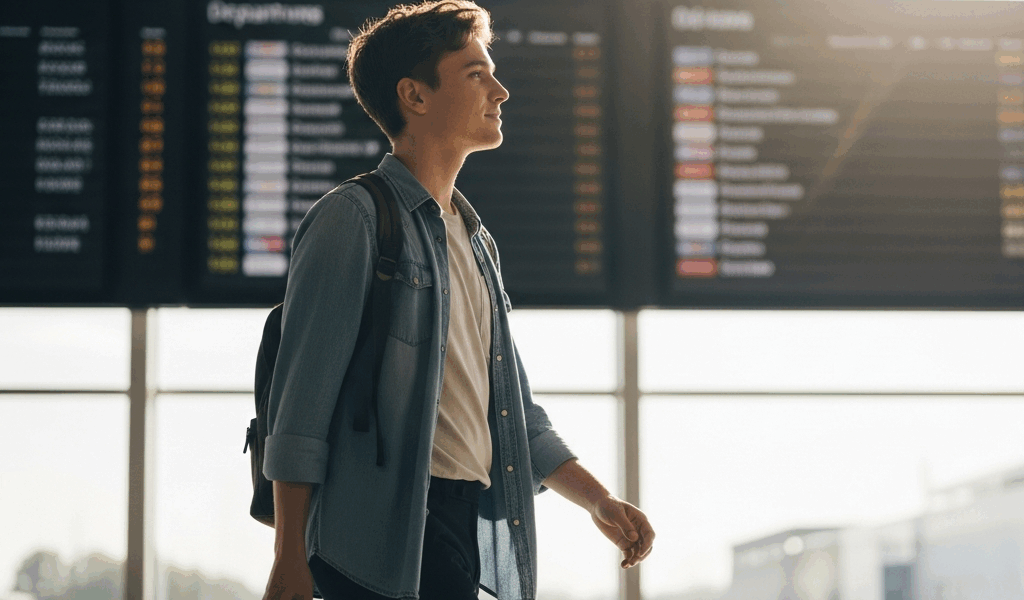
After security, look at the departure screens — large monitors mounted on walls or hanging from ceilings. Find your flight number and it will show your gate assignment, departure time, and status (On Time, Delayed, Boarding). Follow the signs to your gate. Most airports are clearly marked with letters and numbers — Gate B12 means Concourse B, Gate 12.
Gates change. This is the single most important thing to know. An airline can move your flight from Gate B12 to Gate C4 with thirty minutes notice and the only way you will find out is by checking the app or the departure board. Sitting at the wrong gate watching your plane leave from across the terminal is a preventable nightmare. Check the app or the screen every 30 minutes while you wait.
Boarding starts about 30 to 40 minutes before departure. You will hear an announcement and see the gate agent begin scanning passes. Boarding happens in groups — your boarding pass shows your group number. They call groups in order. When your group is called, line up, scan your boarding pass at the reader, walk down the jet bridge, and enter the plane. Find your row number, stow your carry-on in the overhead bin directly above your seat, and sit down. If the overhead is full, a flight attendant will help you find space or gate-check your bag for free.
During the Flight
Takeoff is the part that feels the most dramatic but is completely routine. The engines get loud, the plane accelerates fast, and the nose lifts. Your stomach might drop slightly — same sensation as going over a hill quickly in a car. Your ears will feel pressure as you climb in altitude. Yawning, swallowing, or chewing gum helps equalize them. All of this is normal and expected.
Turbulence feels alarming the first time. The plane bumps and shakes, maybe drops slightly, and your brain screams that something is wrong. Turbulence is the aviation equivalent of a bumpy road — uncomfortable but not dangerous. Pilots fly through it routinely. Keep your seatbelt fastened loosely even when the sign is off, and turbulence becomes a minor inconvenience instead of a panic trigger.
When the seatbelt sign is off, you can get up, use the bathroom, walk the aisle. Flight attendants will come through with drink service — usually free soft drinks, water, juice, and sometimes snacks. Alcoholic drinks are typically $7 to $12. You can bring your own snacks from the terminal. Headphones plug into the armrest jack on some planes, or use your own wireless earbuds for entertainment on your phone or the seatback screen.
Landing involves similar ear pressure to takeoff. The engines get quiet as the plane descends, the flaps extend with a mechanical sound, and the landing gear drops with a thunk you will feel through the floor. The touchdown is a firm bump — sometimes smooth, sometimes firm enough to jolt you. The engines roar briefly in reverse thrust to slow down. All normal.
Landing and Getting Out
After the plane stops at the gate, the seatbelt sign turns off with a chime. Everyone stands up immediately. Do not feel pressured to jump up — the doors take a few minutes to open regardless. Wait for the rows ahead of you to clear, grab your bag from overhead, and follow the stream of people off the plane through the jet bridge into the terminal.
If this is your final destination and you checked a bag, follow the signs to Baggage Claim. Screens near the carousels show which belt has your flight’s luggage. It usually takes 10 to 30 minutes for bags to appear. Stand back from the belt until you spot yours — crowding the carousel makes it harder for everyone.
If you have a connecting flight, check the departure screens for your next gate. You are already past security, so you just need to walk (or sometimes take a shuttle train between terminals) to your next gate. If the connection is tight — under an hour — walk briskly and do not stop for food. If you have plenty of time, grab a meal and recharge your phone at a gate with outlets.
At baggage claim, your ground transportation options are usually rideshare (Uber or Lyft), taxi, rental car, hotel shuttle, or public transit. Most airports have clear signage pointing to each. Rideshare pickup is almost always outside at the curb on the arrivals level — check the app for the exact pickup zone.
That is the entire process. Check in, go through security, find your gate, board, fly, land, leave. Millions of people who are not frequent travelers do this every day without incident. You will be fine — and after the first time, the second flight feels routine.




Leave a Reply