Why Customs Lines Take So Long in the First Place
Customs lines have gotten complicated with all the misinformation flying around — people blame understaffing, bad luck, slow officers. But honestly, it’s none of that. Three things break the system every single time. First, most airports staff their booths based on off-peak demand. So when 15 aircraft land at once, you’ve got a math problem nobody on the floor can fix. Second, people fill out arrival forms while standing in the queue — pen borrowed, papers shuffling, everyone behind them waiting. Third, the kiosks. Those self-service machines are supposed to speed things up, but the moment one unit goes down, 200 people funnel into the remaining five and the whole thing collapses.
Once you accept that customs is a solvable system — not some random lottery you’re stuck in — you stop resigning yourself to the wait. So, without further ado, let’s dive in.
Sign Up for Programs That Let You Skip the Main Line
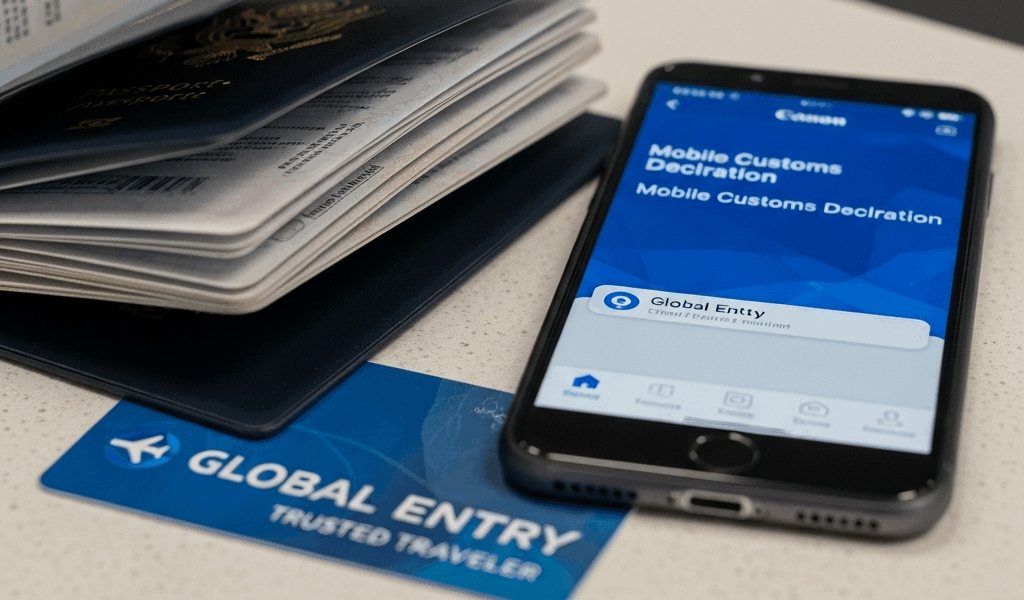
Global Entry costs $100 for five years. That’s $20 a year. For anyone flying internationally with any real frequency, that math is basically a no-brainer. You get trusted traveler status, dedicated kiosks at 50+ US airports, and a line skip that would make you emotional if you’ve ever stood behind 400 people at JFK. But here’s what most people miss — the application process is running 3–5 months right now, and interview slots book up fast. Planning a trip three weeks out? You’re already too late. Apply before your next trip, not the morning you book it.
Your trusted traveler program options
- Global Entry — $100 for five years. Works at 50+ US airports. Also covers Canada, Mexico, and select Caribbean entry points. Requires one in-person interview, roughly an hour. TSA PreCheck is included automatically.
- NEXUS — $120 for five years. Built around the US–Canada border. Covers about 15 major US hubs — fewer than Global Entry — but worth it if you cross into Canada regularly.
- SENTRI — $122.50 for four years. US–Mexico land border specific. Not useful unless you’re in the Southwest or traveling the Baja corridor with any regularity.
- Mobile Passport Control — Free. No interview. No wait for approval. You submit your passport data and a selfie from your phone, then use dedicated kiosks at 40+ US airports. This one move alone cuts 15–20 minutes off your wait.
Mobile Passport Control deserves its own moment here — because most travelers have genuinely never heard of it, and it costs absolutely nothing. Download the app before you board. Register your passport. Snap a selfie at the kiosk when you land. You skip the main line entirely at airports like LAX, JFK, Miami, and Atlanta. You still see an officer, but you’re not standing behind 400 exhausted strangers.
Fly internationally once a year? Global Entry takes patience but pays for itself fast. Fly once every five years? Mobile Passport Control solves roughly 70% of your wait problem at zero cost. Pick accordingly.
Fill Out Your Arrival Forms Before You Land
Probably should have opened with this section, honestly. The single biggest time loss in any customs hall is people filling out arrival forms while standing in the hall itself. We’re talking 25 minutes gone — finding a pen, reading the form twice, asking the officer for directions, moving at half speed while still thinking about question seven.
The US CBP One app lets you submit your arrival form before the wheels even touch down. You scan a barcode at the kiosk and walk straight to an officer. Same function covered by VISITUSA. Flying into Canada? Use ArriveCAN — fill it out on the plane. UK-bound? The Advance Passenger Information form can be submitted 24 hours before landing. That’s it. Done before you’re even tired.
Here’s the part people always skip: have your accommodation address and onward travel details saved as a note on your phone. Not buried in a confirmation email. A note. Most travelers freeze at the kiosk and spend 90 seconds scrolling through their inbox looking for a hotel address while the officer stares at them. Don’t make my mistake — I did exactly this at Dublin Airport in 2019, holding up the entire kiosk lane because I couldn’t find my Airbnb confirmation. Save the address. Save the flight number. Thirty seconds of prep, zero seconds of panic.
What to Do the Moment You Get Off the Plane
This is where the line game actually starts. Walking off the jetbridge, you have maybe 90 seconds before the crowd around you locks in their path. Use them.
Read the signage immediately
Your passport type determines your line. US citizens go one direction. Non-citizens follow entirely different signage. Most people wander — genuinely confused, heads turning — and add unnecessary minutes to their walk before they’ve even reached the hall. The airport designed this signage carefully. Trust it. Commit to the direction it tells you and move with purpose.
Scan the customs hall before queuing
Spend 30 seconds — literally just 30 seconds — reading the room before you pick a line. Most travelers default to the center kiosks because they’re visible and familiar. The fastest lines are usually at the edges, where foot traffic naturally drops off. Three officers with 30-person queues and one officer with eight people? Go to the eight. Also worth noting: booths handling families tend to move slower for the family itself, but solo travelers behind them often process quickly once their turn comes. Read the room. Pick the edge.
Get ready before your turn
Jacket off. Passport open to the photo page. Mask off if you’re wearing one. Forms ready. Accommodation address visible on your phone screen — not locked, not buried. Onward flight number memorized or noted. When you reach the officer, you should be able to answer questions before they finish asking them. A traveler fumbling with a jacket zipper and a crumpled form signals every red flag in the book — even though fumbling is just normal travel exhaustion. The optics matter more than you’d expect.
Common Mistakes That Send You to Secondary Screening
Secondary screening adds 30 to 90 minutes to your arrival. It’s a back room, a longer conversation, and usually a thorough bag check. Avoid it by not doing these things.
Vague answers to direct questions
But what is a vague answer, exactly? In essence, it’s giving three purposes when asked for one. “Oh, just tourism — visiting some friends, maybe a little work.” That’s three separate categories of traveler. Pick one. “Tourism.” Or “Visiting my college friend in Portland.” That’s it. Vagueness triggers secondary screening faster than almost anything else — customs officers are specifically trained to hear inconsistency in phrasing, and “maybe a little work” is inconsistency out loud.
Undeclared items
Frustrated by heavy luggage restrictions, a friend of mine packed a small jar of homemade fig jam from a market in Bologna, figuring it was harmless. That was 2022. Secondary screening happened — 55 minutes, full bag check. Most countries restrict fresh food, processed goods containing animal products, and anything homemade without commercial labeling. When in doubt, declare it. A declaration costs 90 seconds of questioning. Non-declaration costs 45 minutes in secondary — at minimum.
Accommodation info that doesn’t match your story
You say Manhattan. Your booking confirmation says Queens. The officer asks why. If you don’t have an immediate, casual answer — “Better price,” “Staying near a friend in Astoria,” “Availability was gone in Manhattan by the time I booked” — you get flagged. This new problem takes about 40 seconds to solve. Have the answer ready before you reach the booth.
If you end up in secondary anyway
Stay calm. Breathe. Answer what’s asked — nothing more, nothing volunteered. Nervous people get asked more questions. Calm, direct people move faster. In 99% of secondary screening cases, you’ve done nothing wrong. You’ve hit a random audit or a data inconsistency that needs two minutes of clarification. Treat it like that.
The goal here was never to outsmart customs — it’s to signal that you’re organized, honest, and genuinely not worth extra scrutiny. That’s what makes this whole approach endearing to us frequent travelers. Every step above does exactly that, and most of it costs nothing but five minutes of prep before you board.

Leave a Reply