Why Carry-Ons Actually Get Gate Checked
Carry-on rules have gotten complicated with all the conflicting information flying around. As someone who has watched their bag get flagged at the gate twice — both times completely convinced I was fine — I learned everything there is to know about what actually triggers a gate check. Today, I will share it all with you.
The first time, my bag fit the sizer. Barely. The gate agent at a Spirit Airlines flight still pulled it aside because the overhead bins were already stuffed and my soft-sided roller looked oversized once crammed in. The second time, a United gate agent physically measured my personal item. Half an inch over. Gone. What I took away from both situations: gate checks aren’t purely about the rulebook. They’re about discretion, bin capacity, and frankly, how your bag looks when it’s packed like a sausage.
[foxdog-disclosure]
Most travelers assume they get flagged because their bag objectively violates airline dimensions. Sometimes that’s true. The real triggers, though, are messier.
- Full overhead bins on budget carriers. Spirit, Frontier, and Southwest will gate-check bags on packed flights even when they technically meet size requirements. The policy exists, but enforcement is selective — almost arbitrary on bad days.
- Soft bags that expand when packed. A stuffed duffel or soft roller can look twice its intended size. A hard-shell bag that’s oversized at least fails honestly. Soft bags betray you quietly.
- Personal item confusion. Most gate checks aren’t even about the main carry-on. They’re about the backpack, tote, or second roller you’re also dragging onboard. Airlines allow one carry-on plus one personal item. Bring two carry-ons and you’re getting caught.
- Weight limits on specific airlines. Air Canada, Lufthansa, and most European carriers enforce 8–10 kg carry-on weight limits. US airlines rarely weigh carry-ons at the gate — but they will if yours looks suspiciously heavy.
- Gate agent discretion. On oversold or full flights, agents have wiggle room. Your bag might sail through on one flight and get checked on the next one — same airline, same bag.
That’s what makes gate check enforcement so maddening to us frequent flyers. Knowing these triggers beforehand prevents the full-terminal panic of repacking on the floor or paying a checked bag fee you absolutely shouldn’t owe.
The Only Size and Weight Rules That Matter
Probably should have opened with this section, honestly. The rules do matter. They’re just not as consistent as most packing guides pretend.
US Carriers — The Baseline
American, Delta, United, Southwest, and JetBlue all allow carry-ons up to 22″ × 14″ × 9″ (56 × 36 × 23 cm). That’s the standard rolling carry-on size. Almost every bag marketed as “carry-on compliant” hits this. Weight limits exist on paper — typically 40 lbs. (18 kg) buried in fine print — but US domestic flights almost never enforce them.
Where you actually get caught: the personal item. It needs to fit under the seat in front of you, which works out to roughly 18″ × 14″ × 8″ on most aircraft. A full-size backpack won’t fit. A second carry-on definitely won’t. This is the single most common gate-check trigger I’ve personally witnessed at boarding gates.
Budget Carriers — Stricter Enforcement
Spirit and Frontier charge $35–$50 for checked bags on basic fares, which shapes their whole carry-on philosophy. On Basic Economy, you get one personal item only. Want a roller? Pay for the next tier up. Frontier’s carry-on limit is actually 24″ × 16″ × 10″ — slightly larger than the standard — but they enforce it with physical sizers at the gate. Don’t test them.
Southwest is the odd one out. Two free carry-ons, lenient gate agents, and I’ve genuinely never seen them deny a borderline bag. They’re the rare exception worth knowing about.
International and Long-Haul — Where Weight Actually Matters
Air Canada, Lufthansa, British Airways, and essentially every major European carrier enforce 8–10 kg (18–22 lbs.) carry-on weight limits. ANA and Singapore Airlines run similar rules. They weigh bags at check-in or the gate — not just glance at them. A rolling carry-on packed with a laptop, a toiletry kit, and four days of clothes can easily hit 14–15 kg. I learned this on a Lufthansa flight to Berlin, gate B44, where I spent an unglamorous ten minutes transferring half my carry-on into my checked bag in front of a line of annoyed passengers. Don’t make my mistake.
Measure at Home
Buy a carry-on sizer bag from Amazon — they run $15–$30 — or cut a cardboard box to your airline’s exact dimensions. Pack your actual bag the way you’d actually pack it for a trip. Then try to fit it in. Measure width, depth, and height separately. A soft bag that technically passes when empty might still fail when stuffed; the real standard is that it should fit without forcing it.
How to Pack So Nothing Gets Flagged at Security
Security holds don’t automatically cause gate checks, but they slow you down and put your bag under extra scrutiny before you even reach the gate. So, without further ado, let’s dive in.
Liquids — The Real Rule
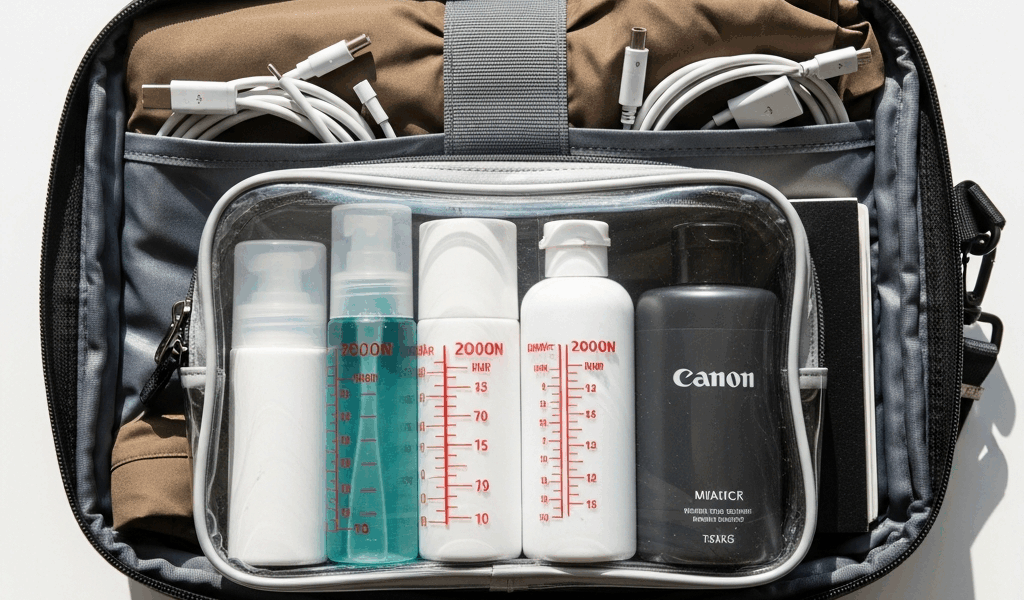
TSA’s 3-1-1 rule: containers maxing out at 3.4 oz (100 ml) each, all fitting inside one quart-size clear bag, one bag per person. What counts as a liquid is broader than most people expect — shampoo, toothpaste, deodorant, sunscreen, moisturizer, peanut butter (yes, genuinely), yogurt, pâté. The container size is what matters, not how full it is. An 8 oz. shampoo bottle with two pumps left still counts as an 8 oz. container. It fails.
Buy travel sizes or decant into smaller bottles — the $3 refillable kind from any drugstore work fine. Solid deodorant: fine. Lip balm: fine. Powder deodorant: fine. Spray deodorant might get held briefly but usually passes. Stick foundation passes. These are the details that save you five minutes at the conveyor belt.
Electronics and Power Banks
Power banks go in carry-on baggage only — never checked. Lithium batteries are a legitimate fire risk in cargo holds, which is why TSA is firm on this one. Most portable chargers fall between 20–50 Wh, well under TSA’s 100 Wh limit. Laptops, tablets, and phones can go in either bag, but agents will likely ask you to pull them out at the security checkpoint for separate screening.
Wrapped Gifts and Odd Shapes
TSA may unwrap and physically inspect wrapped packages or unusually shaped items. Skip wrapping gifts before you fly. Pack the wrapping supplies and do it after you arrive — or just check that bag entirely.
The Packing Method That Actually Fits More
Rolling, folding, and compression all accomplish different things. The goal isn’t just raw volume — it’s making your bag look less bloated when a gate agent eyeballs it at the sizer.
The Rolling Method
Roll clothes tightly from one end into compact cylinders. Rolling saves meaningful space compared to flat folding and keeps wrinkles lower than you’d expect. The tradeoff: finding one specific item mid-trip means undoing your whole packing job. Worth it for shorter trips where you’re unpacking everything at once.
The Flat-Fold Method
Fold clothes flat and stack them vertically like hanging files. Faster to unpack, easier to locate individual items. Takes more space than rolling. Use this if you’re checking a bag or working with a genuinely large carry-on that isn’t pushing any limits.
Compression Cubes
Peak Design or eBags compression cubes — $15–$30 each — compress rolled or folded items further by forcing air out. One or two cubes inside a carry-on makes a noticeable difference in bulk. I’m apparently an eBags person and their Medium cube works perfectly for a week of clothes, while the Peak Design system never quite clicked for me. If your bag is borderline on size, this is the easiest fix available.
[foxdog-inline-cta asin=”B0013KFK74″ title=”eBags Medium Packing Cubes 3-Piece Set” tag=”tripchimp-20″]
The Order That Actually Works
- Heaviest items — shoes, toiletry bags — go near the wheels on a rolling bag, or at the bottom of a duffel.
- Rolled clothes fill the center.
- Soft items like sweaters and socks get stuffed into gaps and corners.
- Laptop and valuables go in the top or front pocket, accessible without unpacking.
- Your personal item — backpack or small tote — carries only what you actually need during the flight: phone, headphones, one book, medications.
A bag packed this way sits flatter and looks less bloated at the gate sizer. Same volume. Better impression.
What to Do If Your Bag Gets Flagged Anyway
Sometimes you follow every rule and still get stopped. Here’s what actually happens next — and how to handle it without paying more than you should.
First, ask the agent directly: is it the size or the weight? If size, and you have 5–10 minutes before boarding closes, you can repack in the terminal. Pull out a jacket, wear it. Redistribute into your personal item. If weight is the issue on an international flight with strict enforcement, you’ll need to either check the bag or physically remove items. On a US domestic flight, they’re rarely actually measuring — they’re making a judgment call on whether it looks oversized. Sometimes just rearranging the bag so it sits flatter is enough.
If the airline is gate-checking your bag because the overhead bins are full — not because you violated a rule — fees are often waived entirely. Ask explicitly. If the agent frames it as a rule violation, the fee typically stands.
Budget carriers like Spirit and Frontier can charge $35–$50 for a gate-checked bag. Major carriers generally don’t charge when the reason is full bins rather than a size violation. Some travel insurance policies — AXA’s higher tiers, for example — reimburse gate-check fees tied to overbooking situations, so read your policy before you get to the airport, not while you’re standing at the gate.


Leave a Reply