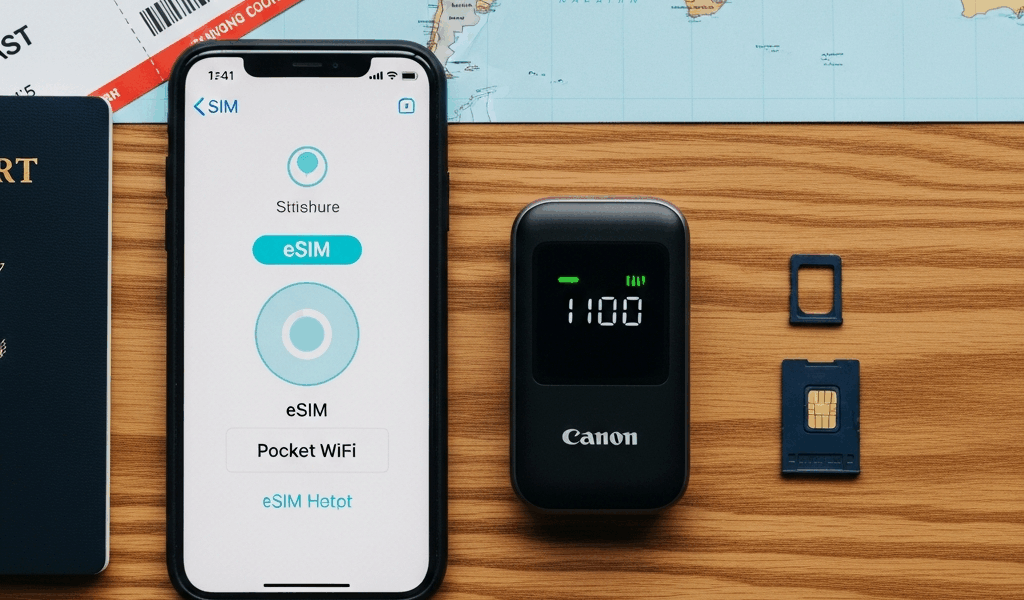
eSIM vs Pocket WiFi vs Roaming — Best Travel Internet in 2026
Travel internet has gotten complicated with all the competing options and carrier marketing flying around. As someone who’s been doing international trips since 2019, I learned everything there is to know about this subject — mostly through expensive mistakes. I was that guy cracking open his AT&T bill after a two-week Europe trip like it was a jury summons. Fifteen dollars a day, per line, adding up quietly while I was busy eating pasta in Naples. Not anymore. I’ve now run all three options across eleven countries and can give you actual specifics — not some hedge-everything “it depends” answer that leaves you more confused than before.
The Quick Answer by Trip Type
You’re probably in one of four situations. Here’s where you land:
- Solo traveler or couple: Get an eSIM. Full stop. Airalo’s Europe regional plan costs around $17 for 10GB and takes five minutes to set up. Nothing else comes close for simplicity and price at that scale.
- Family of four or more traveling together: Pocket WiFi probably wins on per-person cost. One $12/day device covers the whole group. At four people over 14 days, that’s $3/person/day versus roughly $8–12 per person for individual eSIMs.
- Business traveler who needs actual phone calls: Carrier roaming with a real international plan. T-Mobile Magenta and Go5G include free international data in 215+ countries. If you’re on calls all day, you want your actual number ringing — no apps, no workarounds.
- Backpacker going rural: Genuinely complicated. Don’t assume eSIM works everywhere just because it sounds modern. I’ll get into the coverage details below.
Probably should have opened with this section, honestly. Most comparison articles bury the actual recommendation after 2,000 words of throat-clearing. You came here with a specific trip. Now let’s give you the math to back it up.
Real Cost Breakdown for a 2-Week Europe Trip
Baseline scenario: 14 days in Western Europe — France, Spain, Italy, maybe a few days in Germany. Most common international trip for American and Australian travelers, and the scenario where cost differences between options are most dramatic.
eSIM — What You Actually Pay
Airalo’s “Europe” regional eSIM covers 39 countries. Their 10GB plan runs $17, their 20GB plan is $27. Holafly takes a different approach — unlimited data for 14 days at around $49, which sounds expensive until you realize you won’t spend a single minute tracking your usage.
For most travelers, Airalo’s 10GB at $17 is plenty. Streaming video will eat it fast — but maps, messaging, occasional browsing over two weeks? Rarely a problem. I used 6.2GB on a 12-day Italy trip that included heavy Google Maps and some Instagram posting. Never got close to the limit.
Solo traveler, two-week Europe trip: $17–$49 total, depending on your data habits.
Two people traveling together: $34–$98 total, because each person needs their own eSIM on their own device.
Pocket WiFi — The Per-Day Math
Pocket WiFi rentals for Europe typically run $8–$14 per day through companies like Tep Wireless, Solis, or airport kiosks. Solis rents their MiFi device for around $9/day with unlimited data. Most services charge a $49–$80 deposit returned when you bring the device back.
Don’t make my mistake. Got burned by a pocket WiFi rental at Charles de Gaulle once — didn’t read the fine print, didn’t realize “unlimited” meant throttled after 500MB daily. That’s nearly useless for a family trying to navigate Paris on a Tuesday afternoon.
14 days at $9/day = $126 total, plus deposit. That’s $126–$175 for the trip — covering everyone traveling with you.
Here’s where the family math flips everything:
- Solo traveler: Pocket WiFi costs $126. eSIM costs $17. eSIM wins by $109.
- Couple: Pocket WiFi costs $126. Two eSIMs cost $34. eSIM still wins by $92.
- Family of four: Pocket WiFi costs $126. Four eSIMs cost $68–$196. Pocket WiFi wins or ties, depending on which plans you pick.
- Family of five or six: Pocket WiFi almost always wins. $126 divided by five people is $25.20 per person for two weeks of data. Hard to beat that with individual eSIMs unless everyone goes bare minimum.
Carrier Roaming — The International Plan Reality
T-Mobile’s Magenta and Go5G plans — starting around $70/month for a single line — include unlimited texting, 5GB of high-speed data, and unlimited 128kbps data internationally across 215+ countries. No extra charge. If you’re already on T-Mobile, international data is already paid for.
AT&T’s International Day Pass costs $12/day per line, capped at $120/month per line. 14-day trip: $120 per person. Two people: $240. Family of four: $480. That number should make your eye twitch a little.
Verizon’s TravelPass runs $10/day per line. Similar math, similar ouch.
The sleeper pick here is T-Mobile. Already on Magenta or Go5G and traveling even once a year? The roaming math works in your favor — especially solo or as a couple. The catch is that 128kbps “unlimited” data after 5GB is essentially unusable for maps or anything interactive. Barely email, honestly.
Setup and Hassle Factor
Setup complexity is where these options separate themselves beyond cost. Travel friction is real — I’ve watched perfectly intelligent people standing outside an airport in Milan having a full meltdown over their SIM card situation. There’s a version of this that’s entirely avoidable.
eSIM — Five Minutes, No Hardware
Assuming your phone supports eSIM — and in 2026, nearly every flagship released in the past four years does, including iPhone 14 and later, Samsung Galaxy S22 and later, Pixel 6 and later — setup is fast. Download the Airalo app, buy the plan, scan the QR code, done. I did it in the Uber on the way to JFK once. No phone store visit, no tiny SIM ejector tool that’s definitely lost somewhere in a junk drawer, no hardware to keep charged.
The one thing people miss: activate your eSIM before you land. You need a data connection to install it initially. Trying to set it up on airport WiFi in a foreign country while running on three hours of sleep after a nine-hour flight is avoidable stress — and yet people do it constantly.
Pocket WiFi — The Logistics Tax
Pocket WiFi works. But it comes with a tax of minor daily inconveniences that compound over a two-week trip — the kind of thing that sounds manageable in theory and quietly irritating in practice.
- Pickup: Usually at an airport kiosk or hotel desk. If your flight’s delayed, your rental window shifts awkwardly.
- Charging: Most devices give 8–12 hours of battery. You will forget to charge it at least once. When it dies mid-navigation in an unfamiliar city, everyone immediately looks at whoever was responsible for it.
- Return: You have to physically return the device at the end of your trip — usually back to the airport kiosk. Early morning flight means returning it the night before, losing your last evening of connectivity.
- It’s another object to carry, track, and not leave on a restaurant table in Seville.
Frustrated by exactly that situation at Heathrow in 2023, I stood in a 25-minute return queue — dead pocket WiFi device in one hand, carry-on I was already annoyed at in the other — and made a decision. That’s when I fully switched to eSIM for solo trips. Haven’t looked back.
Roaming — Zero Setup, Maximum Surprise
But what is roaming’s actual advantage? In essence, it’s effortless activation. But it’s much more than that — it’s also the thing most likely to generate a surprise charge if you’re not paying attention. Turn your phone on in Paris and it works. No apps, no hardware, no prep. The danger is that “it just works” feeling can mask what’s quietly happening to your bill if your plan doesn’t properly cover your destination. People still get hit with $400 roaming charges in 2026. Apparently some lessons take longer than they should.
Coverage Gaps Nobody Mentions
Coverage marketing is optimistic in ways that will frustrate you at inconvenient moments. This section exists because of that.
eSIM Coverage — The Provider Dependency Problem
eSIM providers don’t own towers. They’re MVNOs — they buy access from local carriers and resell it through a clean app interface. Your coverage is only as good as whichever local carrier your provider has a deal with in that specific country.
In Italy, Airalo typically routes through WindTre — solid urban coverage, but patchy in smaller towns and mountainous regions. In rural France, some Airalo plans struggled in areas where Orange had signal. The eSIM just isn’t accessing Orange’s network because there’s no partnership agreement in place.
Before buying, check which local carrier your provider partners with in each country, then look up that carrier’s actual coverage map. Ten extra minutes of research. Prevents real problems.
Pocket WiFi — Rural Areas Are a Gamble
Pocket WiFi devices typically piggyback on whatever signal is available — sometimes switching between carriers for best signal, sometimes locked to one. The honest reality: in rural Tuscany, the Dolomites, or anywhere more than 30 kilometers from a major city, pocket WiFi coverage gets unreliable regardless of what the rental company’s marketing says.
These devices are built for urban travelers. That’s what makes pocket WiFi endearing to us city-focused itinerary types — and exactly what makes it frustrating the moment you deviate from that plan.
Roaming — Usually the Best Coverage
This is the one area where carrier roaming genuinely wins. T-Mobile, AT&T, and Verizon international roaming typically uses local Tier 1 carriers — Orange in France, Vodafone in the UK, TIM in Italy. Best networks in their respective countries. If signal exists anywhere, your roaming plan will usually find it.
That matters enormously for rural areas, small islands, mountain regions — places where a smaller carrier won’t have infrastructure. A hiker in the Swiss Alps has a better shot with a US carrier’s roaming agreement with Swisscom than with a budget eSIM routing through a secondary carrier. Not even close, actually.
The Verdict
In 2026, here’s what I actually tell people — and having done this long enough, a lot of people ask:
Solo travelers and couples: Airalo. Buy a regional eSIM before you leave. 10GB for $17 covers most trips, or $27 for 20GB if you’re a heavy user. Set it up at home, activate when you land, never think about it again. Beats every other option on cost and convenience at this scale.
Families of four or more traveling together: Solis or Tep Wireless pocket WiFi. Solis’s MiFi device at roughly $9/day covering your whole group is hard to beat. Budget $130–$160 for the full trip including the deposit — and assign one person in the family responsibility for charging it every night. That one thing will save you genuine grief.
T-Mobile Magenta or Go5G subscribers: use your existing plan. You’re already paying for it. International data is included. 5GB of high-speed data is enough for most people on a two-week trip if you’re not streaming video — keep an offline Google Maps download as backup for when you hit the ceiling.
AT&T or Verizon customers: skip the international day pass unless your company is covering it. Ten to twelve dollars per day per line adds up to a number that’s embarrassing when it appears on your bill. Buy an eSIM instead, put your SIM on airplane mode, move on.
Going rural: Layer your options. eSIM as primary — then before heading off-grid, download offline maps, save your WhatsApp conversations, grab any documents you’ll need. In truly remote areas, no consumer travel internet option is reliably good. Worth accepting before you leave, not while standing lost on a gravel road outside Siena at dusk.
The honest summary: eSIM wins for 80% of travelers in 2026. Cheaper, simpler, good enough. Pocket WiFi wins one specific scenario — large families staying physically together who can share a single connection. Roaming wins if you’re on T-Mobile’s right plan or you’re a business traveler who genuinely needs your real number reachable at all times. Everything else is noise from providers trying to sell you their product.



Leave a Reply