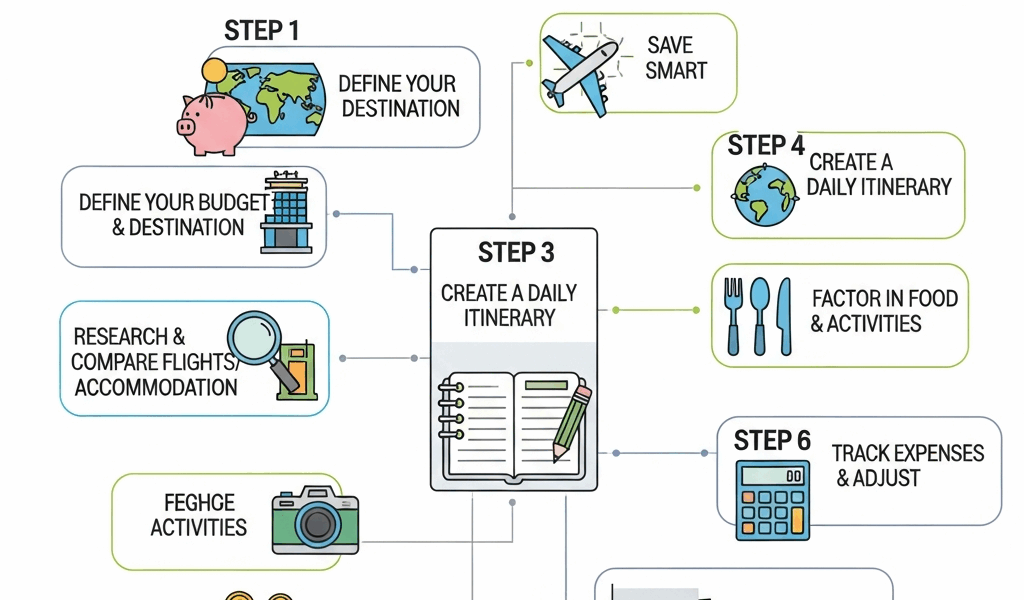
How to Plan a Trip on a Budget — Step by Step for First-Timers
Budget travel has gotten complicated with all the conflicting advice flying around. As someone who took their first solo international trip in 2017 on $1,800 total — two weeks in Southeast Asia — I learned everything there is to know about making money stretch further than it has any right to. Came home with $200 to spare and a deeply inconvenient travel addiction. Thirty-something trips across six continents later, I can tell you the process I use now looks nothing like what most travel guides describe. The order matters. The specific tools matter. And there are about three spending categories that will quietly gut your budget if you don’t spot them coming.
This guide walks through that process step by step — not vague suggestions, but the actual sequence I follow every single time.
Set Your Budget Before You Pick a Destination
Most people do this completely backwards. They fall hard for a destination — usually from an Instagram reel or a friend’s photos — book flights on impulse, then scramble to figure out how to afford it. I did exactly this with Iceland in 2019. Brutal lesson. Ten days, nearly $4,000, and I was eating gas station sandwiches by day six — standing in a parking lot in Reykjavik, wind whipping at my face, wondering what went wrong.
The correct sequence: decide your total available spend first, then use that number to filter where you can realistically go.
Start with a hard number. Not a range. A number. Say it’s $2,500 all-in. Subtract estimated flights — use Google Flights to ballpark, not to book yet — and whatever’s left is your on-the-ground budget. Divide that by your travel days. That daily figure tells you which regions are genuinely viable.
If your daily on-the-ground number lands around $40, Vietnam and Thailand are wide open. Portugal might work if you’re disciplined. Japan is borderline. Norway isn’t happening this trip.
This filter alone saves weeks of wasted planning. Set the number. Then pick the destination.
Flight Booking Strategies That Save 30-50%
Burned by years of overpaying, I now spend more time on flight research than almost anything else. Here’s what actually moves the needle — and one popular tip that definitively doesn’t.
Use Google Flights Price Explorer
Go to Google Flights, enter your departure city, leave the destination blank, and switch to map view. You’ll get a color-coded map showing the cheapest available fares from your airport to everywhere. That’s how I found a $340 round-trip from Chicago to Lisbon in 2022 — I had zero plans to go to Portugal. Budget first, destination second. The tool rewards that approach.
Fly Tuesday or Wednesday
Not a myth. Not a small difference, either. I consistently see $60-$150 gaps between midweek departures and Friday or Sunday flights on identical routes. Demand craters on Tuesday and Wednesday mornings — airline pricing systems respond accordingly. Any schedule flexibility you have, use it here. Pocket the difference.
The Incognito Mode Myth
Probably should have opened with this section, honestly, because this piece of flight advice gets repeated everywhere — and it’s just not true. Airlines don’t raise prices based on your browser cookies. Price changes between searches happen because seat-class inventory shifts in real time — other people are buying those seats while you’re deliberating. Incognito mode does nothing useful. What actually helps: search in a single session, have your card ready, and book when you see a fare you’re comfortable with. Waiting for it to drop further usually doesn’t pay off.
Set Price Alerts Early
Google Flights and Hopper both let you track specific routes over time. I set alerts 3-4 months out for any trip I’m seriously considering. The sweet spot for international bookings is typically 6-8 weeks out for budget carriers, 2-3 months for long-haul routes. I once watched a Chicago-Bangkok fare sit at $580, then drop to $490 over three weeks — by doing nothing except waiting and reading the alert emails every few days.
Accommodation — Beyond Hotels
Hotels are a fine product. They’re also almost never the best value play for budget travelers — especially solo or small-group trips.
Hostels — Still Relevant, Often Excellent
A good hostel dorm bed in Southeast Asia runs $8-$15 a night. Eastern Europe, $15-$25. Even in Western Europe, clean and well-located hostel beds exist for $30-$45 in cities where a basic hotel room costs $120. The quality gap between a bad hostel and a good one is enormous — check Hostelworld ratings and read recent reviews specifically for cleanliness and noise. A 9.0+ rating on Hostelworld is almost always genuinely good. Anything below 8.0, don’t bother.
Private hostel rooms are worth comparing against budget hotels, too. Often nearly the same price, better location, and a common area that actually has life in it.
Airbnb for Groups
Solo traveler? Hostels win on price, full stop. Group of three or more? Run the Airbnb math first. A $120/night apartment split three ways is $40 per person — cheaper than most decent hostel private rooms, and you get a kitchen. That kitchen matters more than it sounds. Two weeks somewhere, skipping restaurant breakfasts — I budget $5-$8 for groceries in the morning versus $12-$18 at a café. It adds up fast.
House-Sitting
This is the wildcard most people completely overlook. TrustedHousesitters runs about $129 a year for membership — in exchange, you get access to listings worldwide. Homeowners who need someone to stay in their house and look after their pets while they travel. Free accommodation. Genuinely free. The catch is competitive applications and a few months needed to build a profile with reviews. Don’t make my mistake of trying to set it up two weeks before a trip. Get it running early. I’ve done four house-sits that collectively saved me around $2,400 in accommodation costs.
Overnight Transport as a Hotel
Sleeper trains and overnight buses across Southeast Asia and Eastern Europe pull double duty — they move you between cities and eliminate a night’s accommodation cost entirely. The overnight train from Hanoi to Da Nang runs about $20 for a soft sleeper berth. You arrive having paid nothing for a bed. Factor this into your routing when it makes geographic sense.
Daily Spending by Region
These are realistic daily budgets covering food, local transport, and entrance fees — not the aspirational numbers certain travel blogs like to publish. These are what I’ve actually spent, averaged across multiple trips to each region.
Southeast Asia — $30 to $50 Per Day
Vietnam, Thailand, Cambodia, Indonesia — the budget sweet spot. At $30/day you’re staying in hostels, eating street food — which is often better than restaurants anyway — and riding local buses. At $50/day you’re eating at sit-down spots, occasionally grabbing a Grab, doing one paid activity per day — a cooking class, a boat tour, a temple complex with a fee. This region is genuinely forgiving for first-time budget travelers. That’s what makes Southeast Asia endearing to us budget-obsessed planners.
Eastern Europe — $50 to $80 Per Day
Poland, Hungary, Romania, Bulgaria, the Balkans — dramatically better value than Western Europe. Krakow is cheaper than nearly every Western European city I’ve visited. A sit-down meal with a beer in Krakow runs $10-$12. A week-long tram pass in Budapest costs about $12. Budget around $60/day and you’ll eat well, move around without stress, and still fit in a museum or two.
Western Europe — $80 to $150 Per Day
The range is wide — it depends heavily on which city. Lisbon and Porto sit at the low end, $80/day is workable. Paris, Amsterdam, and Zurich push toward $120-$150 even when you’re being careful. Plan for this region honestly. The travelers who spiral in Western Europe are almost always the ones who planned a Southeast Asia budget and landed in London.
The Three Expenses That Blow Every Budget
I’ve watched this happen to other travelers and lived it myself. Three specific categories drive the majority of budget overruns — and each one has a concrete fix.
Airport Transfers
Official airport taxis are expensive almost everywhere. The metered cab from Rome Fiumicino into the city center carries a fixed rate of €50. The airport express train costs €14. That’s a €36 difference — and actually a faster trip. Research the public transit option for every airport you’re arriving at before you fly — not when you’re jet-lagged at midnight and someone’s waving a taxi sign at your face. I keep this information in a Notes app entry for every destination before I leave home.
Rideshare apps work in most major cities and undercut taxi ranks significantly. Grab covers Southeast Asia. Bolt works across most of Europe. Download the app and set up payment before you land.
Tourist-Trap Restaurants
The restaurant immediately next to any major tourist attraction carries a 40-60% markup over a place two streets away. Not a slight bump — a real one. Spots near the Trevi Fountain, the Eiffel Tower, Angkor Wat — all of them charge tourist prices because they can. Walk two blocks in any direction. The ratio of locals to tourists in the dining room is a reliable quality-and-price signal.
Lunch is the strategic meal for budget travelers. Many European restaurants offer a fixed lunch menu — two or three courses for €10-€15 — that would cost €30+ at dinner. Same kitchen, same food, different hour.
Data Roaming
Your home carrier’s international data plan is almost always a bad deal. A local SIM in Thailand costs about $8 for 15GB valid for 30 days. A US carrier roaming add-on for the same period runs $60-$100 — less data, slower speeds. Buy a local SIM at the airport on arrival — ten minutes, $50-$90 saved per trip. For shorter trips or multi-country Europe travel, a Google Fi or Airalo eSIM is worth the setup time.
Planning a budget trip isn’t about cutting everything to the bone. It’s about making deliberate choices before you leave — so you’re not making panicked ones while you’re there. Get the sequence right: budget first, then destination. Spend real research time on flights and accommodation. Know your regional daily targets. Close the three budget leaks before they open. That’s the whole system. It works.


Leave a Reply