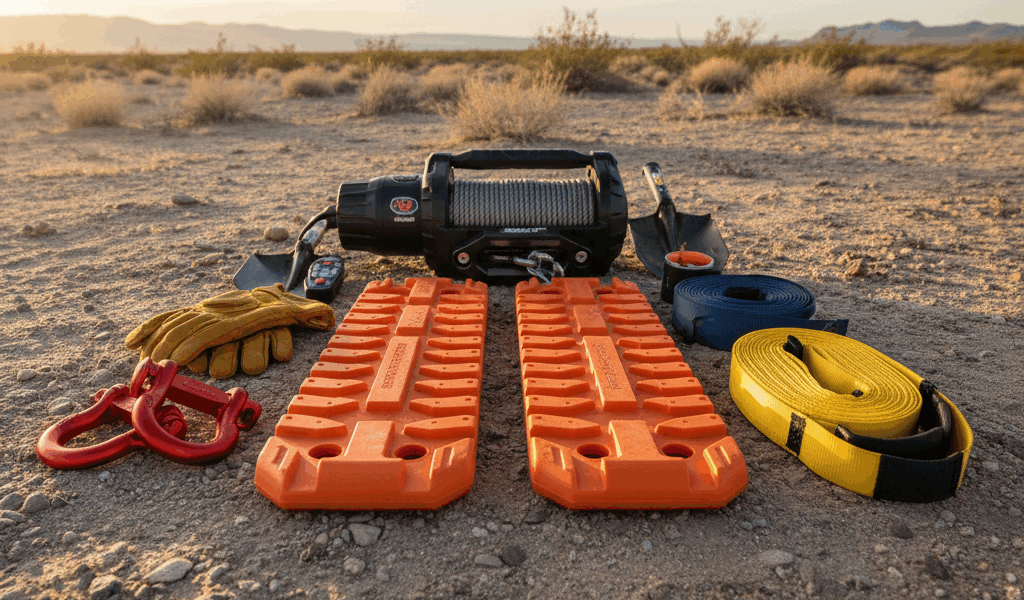
Essential Recovery Gear for Overlanding

Getting stuck is part of overlanding. Whether it’s deep sand, thick mud, or an unexpected obstacle, proper recovery gear transforms a potential trip-ender into a minor inconvenience. The difference between a well-prepared overlander and a stranded one often comes down to having the right equipment and knowing how to use it.

This guide covers essential recovery gear for overlanding, from basic must-haves to advanced equipment for remote travel.

Off-road trail mountain view requiring recovery gear
Challenging terrain demands proper recovery equipment for safe travel.

The Core Recovery Kit

Every overlander should carry this basic equipment, regardless of how challenging their planned routes are:

Recovery Strap (Snatch Strap)

A kinetic recovery strap uses elastic energy to help extract stuck vehicles. Unlike tow straps, they stretch and snap back, providing additional pulling force.

  • Recommended size: 3″ wide x 30′ long minimum
  • Breaking strength: At least 2-3x your vehicle’s GVWR
  • Key feature: Looped ends (no metal hooks that can become projectiles)
Jeep Wrangler off-road vehicle recovery
Proper recovery points and equipment are essential for every overland vehicle.

Recovery Points

Factory tow hooks aren’t designed for recovery forces. Proper recovery points bolt to the frame and handle the stress of extraction.

  • Front and rear points are ideal for maximum versatility
  • Rated shackles connect straps to recovery points safely
  • Never use tie-down points for vehicle recovery

Soft Shackles

Made from high-strength synthetic rope, soft shackles are lighter and safer than metal D-rings.

  • Advantages: No metal to become a projectile, lighter weight
  • Working load: Match or exceed your recovery strap rating
  • Tip: Carry at least two for versatility

Traction Aids

Recovery Boards

Plastic or composite boards that provide traction when placed under spinning tires. Brands like Maxtrax have become essential overlanding equipment.

  • Use cases: Sand, mud, snow, and soft surfaces
  • Quantity: A pair covers most situations; four provides maximum versatility
  • Tip: Practice using them before you need them in the field
Desert road adventure travel
Desert sand and soft surfaces are common situations requiring recovery boards.

Shovel

Sometimes the best recovery tool is removing what’s trapping you. A quality shovel handles digging out tires, clearing obstacles, and campsite preparation.

  • Types: Folding (compact storage) vs. full-size (more leverage)
  • Features to look for: Sturdy handle, pointed blade, compact storage

Self-Recovery Equipment

Hi-Lift Jack

The iconic hi-lift jack lifts vehicles high enough to place recovery boards or clear obstacles beneath tires.

  • Requirements: Proper lift points on your vehicle (bumper or rock sliders)
  • Caution: Inherently unstable – requires training and care
  • Accessories: Base plate for soft ground, lift-mate for pinch-weld lifting
Pickup truck adventure vehicle
Trucks and SUVs need recovery equipment matched to their size and weight.

Winch

The ultimate self-recovery tool. A winch lets you extract yourself when no other vehicle is available.

  • Sizing: Generally 1.5x your vehicle’s gross weight minimum
  • Line type: Synthetic rope (safer) vs. steel cable (more durable)
  • Accessories needed: Tree saver strap, snatch block, gloves, winch damper

Winch Accessories

A winch alone isn’t enough. Essential accessories include:

  • Tree saver strap: Protects trees and provides safe anchor point
  • Snatch block: Doubles pulling power and enables angle pulls
  • Winch damper: Weighs down the line in case of breakage
  • Heavy gloves: Protect hands when handling cable or rope
Forest road trail
Forest trails often provide anchor points for winch recovery when needed.

Air Management

Tire Deflators

Lowering tire pressure dramatically improves traction on sand, snow, and rocky terrain.

  • Target pressure: Often 15-20 PSI depending on terrain and tire
  • Deflator types: Manual valve cores, automatic preset deflators
  • Important: Know your tire’s minimum safe pressure

Air Compressor

After airing down, you need to air back up before highway driving. A quality compressor is essential.

  • Types: Portable (12V) vs. on-board (permanently mounted)
  • Key specs: CFM output determines inflation speed
  • Recommendation: Look for at least 2.5 CFM for reasonable inflation times
Outdoor camping gear setup
Organized recovery gear should be easily accessible when you need it most.

Building Your Recovery Kit

Beginner Kit ($150-$300)

  • Quality recovery strap with soft shackles
  • Folding shovel
  • Tire deflators
  • Basic 12V air compressor
  • Tow strap for non-kinetic pulls

Intermediate Kit ($500-$1,000)

  • Everything in beginner kit
  • Recovery boards (pair)
  • Hi-lift jack with accessories
  • Better air compressor
  • Recovery gear bag for organization

Advanced Kit ($2,000+)

  • Everything in intermediate kit
  • Winch with full accessory kit
  • On-board air compressor
  • Second set of recovery boards
  • Pull pal or ground anchor
4x4 adventure camping vehicle
A well-equipped vehicle carries recovery gear matched to its intended adventures.

Safety First

Recovery operations are inherently dangerous. Follow these principles:

  • Inspect gear before each use – Check for damage, wear, and proper ratings
  • Keep bystanders clear – The danger zone extends well beyond the recovery line
  • Use a winch damper – Reduces energy if a line breaks
  • Never exceed ratings – If equipment is undersized, don’t use it
  • Take a recovery course – Hands-on training prevents accidents

The best recovery is the one you don’t need. Scout ahead, know your limits, and choose routes appropriate for your vehicle and experience level. But when you do get stuck, proper gear and knowledge gets you moving again safely.

tripchimp

tripchimp

Author & Expert

tripchimp is a passionate content expert and reviewer. With years of experience testing and reviewing products, tripchimp provides honest, detailed reviews to help readers make informed decisions.

6 Articles
View All Posts

Leave a Reply

Your email address will not be published. Required fields are marked *

Subscribe for Updates

Get the latest articles delivered to your inbox.